Showing posts with label Books. Show all posts

Wednesday, January 8, 2014

Mohsin Hamid - How to Get FILTHY RICH in Rising Asia

Finally, finally, here it is - the review I promised you so many months ago.

I stumbled across this book by accident. I loved Mohsin Hamid's The Reluctant Fundamentalist but had no idea Hamid had published other books since. I was looking for a new book to read and trawled through my go-to book-related sites (which include various book blogs, Amazon, the Guardian books section, the New York Times and Goodreads). And I started hearing good things about this book with a funny title. In a Booker discussion group on Goodreads, for example, this book joined members in unanimity - they all thought it was a shoe-in for the longlist (in fact it was NOT longlisted, though Hamid has previously been on the shortlist for TRF).  When I saw that it was by Mohsin Hamid, my mind was made up and I lifted my finger for that all-important 'click' which is the simple action of purchasing a Kindle book on Amazon.

It was soon obvious this was a good choice. After reading only a few pages I was in. The story moves at a galloping pace and the portrait depicted of Pakistan is neon vivid. Bearing some initial resemblance to Aravind Adiga's book White Tiger (though that was set in India), How to Get Filthy Rich is the story of a poor boy rising to the heights of corporate success in Asia.

Hamid chooses to tell the story in the second-person, which is quite rare, and he uses an unusual conceit: the book is written as though it were a self-help book. Each chapter doles out a different piece of advice about how to transform oneself from a peasant living in an impoverished rural environment to a wealthy entrepreneur in a big city. There are chapters entitled 'Learn from a Master', 'Work for Yourself' and 'Befriend a Bureaucrat'. Hamid is heavy on the irony and much of the book is darkly comical.

Initially I was resistant to both the second-person narration and the self-help lingo, but I soon fell into the story. The thing about second-person narration is that it forces the reader to become subjectively involved in the story. It personalizes everything. You become the hero. So that when something happens to 'you', we feel like it might be happening to us. It works.

The facade of the self-help book, however, is potentially a different story. Yes, it provides Hamid with the ability to comment, at the start of each chapter, on the plight of those living in modern-day Asia, on the notion of self-help books as a genre (a genre which is parodied here with brutal accuracy), and on the notion of selfhood itself - 'the idea of self in the land of self-help is a slippery one'. It allows him, in short, to ruminate on bigger political and philosophical issues, outside of the story he is telling at the book's core. The obvious problem with this is that it takes him (and us) outside of the story. But the conceit also allows Hamid to tell a story that is bigger than the characters. The characters are devices, in some way; their story is a synecdoche for the greater story, that of Pakistan itself.

Hamid is such an effective story teller that I was never weighed down by lofty political commentary. I was quickly caught up in the vivid coming-of-age story at the centre of the narrative, about a man (whose name we never learn), his quest for success, and the woman he has always loved. It is a tale about what it takes to succeed in a land still weighed down by a deeply entrenched class system and systemic corruption. The frequent interruptions for philosophical musings didn't disrupt my enjoyment of the book. In fact, in retrospect, they probably enhanced it. What might seem clunky and contrived at the start becomes contextual enrichment by the end. Reviewing the book now I realize that it is about so many things - Hamid does so much, so well. This is a love story and a political story. It is a farcical self-help book. It is a book about the notion of 'self', about how fast life moves and how critical it is to seize what is important to you when you have the time to do so. It is also a book about writing and creating fiction. All of this works to keep us readers distanced, to some degree, from the characters central to the Bildungsroman around which all of this is constructed. And yet by the end I was surprised at the extent of my engagement with that story. I was so engaged, in fact, that I was moved to tears by the final scenes.

This is such an original book and, mostly, it works. Hamid is a wonderful writer. I thought of the book several times during our travels, so it has stayed with me. I highly recommend it to anyone who enjoyed Adiga's White Tiger, to anyone who likes a good story told in a new voice, to anyone who enjoys a bit of politics spicing up their fiction.

Overall assessment: 4 out of 5 stars.

Favourite Passages: 'We are all refugees from our childhood. And so we turn, among other things, to stories. To write a story, to read a story, is to be a refugee from the state of refugees. Writers and readers seek a solution to the problem that time passes, that those who have gone are gone and those who will go, which is to say every one of us, will go. For there was a moment when anything was possible. And there will be a moment when nothing is possible. But in between we can create.'

'But when you read a book, what you see are black squiggles on pulped wood, or, increasingly, dark pixels on a pale screen. To transform these icons into characters and events, you must imagine. And when you imagine, you create. It's in being read that a book becomes a book, and in each of a million different readings a book becomes one of a million different books, just as an egg becomes one of potentially a million different people when it's approached by a hard-swimming and frisky school of sperm. Readers don't work for writers. They work for themselves. Therein, if you'll excuse the admittedly biased tone, lies the richness of reading.'

Sunday, August 11, 2013

Richard Beasley - Me and Rory MacBeath


It seems fitting, somehow, that I will have read more Australian novels this year than in any previous year. It is, after all, the year I am departing Australia. Call it a farewell salute. This one, by Richard Beasley, is set in 1970s Adelaide. The last book I read by Richard Beasley was Hell Has Harbour Views, and whilst I enjoyed both that and Me and Rory MacBeath immensely, they could not be more different. Hell Has Harbour Views is a cynical, satirical look at big city law firms and the nasty practices and people that are to be found therein. Me and Rory MacBeath is a hugely moving coming-of-age story about a boy who lives in the wealthy suburbs of Adelaide with his barrister mother, Harry, and whose friendship with a boy called Rory changes him forever. In my opinion, it is the better book, and marks Beasley as an Australian writer for our times, one who will be remembered.

Jake is a sweet twelve year old boy whose life thus far has been reasonably sheltered and defined by his privileged suburban neighbourhood - running through sprinklers, playing backyard cricket with his best mate Robbie who lives just a few houses away. He lives with his mum, Harry, who is single and who teaches Jake to argue persuasively and to use words, not fists, when he's angry. Jake and Robbie know everyone in their neighbourhood, from Mr Nixon, who strictly guards his wife's precious garden against encroachment by footballs, cricket balls and the like, to the Williams, whose daughter is Jake's young crush. Jake's biggest worries are the balls he loses over the Nixons' fence and the embarrassment caused by his having once seen Mrs Williams ironing without a top on. That is until Rory moves in to the neighbourhood.

All of a sudden backyard cricket takes on a new dimension - it is England against Australia against Scotland, which everyone knows doesn't work, three being a crowd in backyard or front-yard cricket. At first Jake doesn't understand what Rory is good for, but when he sees Rory string a fishing line, gut a fish, and fight a bully he suddenly realises there is room in his life after all for one more friend. Before long Rory, Robbie and Jake are inseparable and life seems to be one long summer. Robbie's dad takes them away on fishing trips, they camp overnight in Robbie's backyard, they listen to Harry's lawyer mates getting drunk during parties at Jake's house.

But it is a formative period in their lives and before long they are exposed to things that have them growing up quickly. Jake is sent to a new school, and slowly sees less of both Robbie and Rory, and when Rory's life undergoes a shocking change Jake finds himself having to navigate through the murky waters of adult morality to decide where his own values lie.

Beasley writes beautifully here, capturing the essence of boyish youth perfectly. Much of the humour in the book arises from Jake's quoting of his mother's sardonic quips, not understanding that they were meant in jest - it comes across as entirely real and believable. I found myself particularly drawn to the characters of Jake and Harry, who is brilliantly portrayed as a chain-smoking, wine-swilling single mum who is a force against evil in the courtroom, and who "smokes her cigarettes differently after court than the way she did before court".

The courtroom drama which occupies a third of the book is fascinating and richly illustrated, and the story as a whole is true to the time in which it is set. A judge who is faced by a woman driven to extreme action after years of violent abuse at the hands of her husband comments that "her marriage was an unfortunate one", capturing at once the stilted language of a judicial figure and the rampant chauvinism of the 1970s.

Jake's endless summer comes to an end in a touching and believable way when he realises his life will never be the same as it once was, and that whilst he wasn't yet a man, he "didn't feel like a boy either." I was moved by this story and am pleased to have found an Australian novel which reflects and immortalises a particular kind of suburban upbringing, one to which I can relate.

Overall assessment: 4.5 out of 5.

Favourite passages: Beasley's use of language is highly evocative for much of the novel, such as when he describes a boy at Jake's school as one with "small footprints, their impact slight, almost nothing, amid a school where other boys stomped around." He gets the tone of a boy on the brink of adulthood just right, infusing Jake's narration with a kind of innocent wisdom that is highly endearing. For example, describing his mother in action in the coutroom, Jake says:

"Harry put her hand on her head then and straightened her wig. It was one of the things she did a lot. Whenever she finished a point, an important one, she often adjusted her wig. But in reality, she unstraightened it. She seemed to like it to be ever so slightly on an angle, not quite comically so, but just enough to give the impression, if you did make assumptions, that she thought wearing a barrister's wig was just a bit funny, or odd. It was like a wink to the jury."

This one is really worth a read.

Tuesday, August 6, 2013

Madeleine St John - The Women in Black


Not to be confused with the West-End-play-turned-Daniel-Radcliffe-film The WomAn in Black, this is a charming little book about women working in a department store in Sydney during the late 1950s. Madeleine St John was a graduate of the University of Sydney with contemporaries such as Clive James and Bruce Beresford, and she wrote four books late in life, one of which was short-listed for the Booker. The Women in Black is a delightful story which deftly and lightly depicts the lives of women in Sydney at a particular time.

F. G. Goodes is an elegant department store, much like I imagine David Jones was in its day, an icon in the Sydney CBD, where the best of the best is sold. The women who work there wear a smart black uniform and come to know much about one another. St John depicts their lives with sardonic humour, yet she clearly empathises with the characters and sympathises with their subjection to the times and traditions in which they live.

The story focuses on four women who staff the ladies' cocktail dress department. Patty is a childless woman whose dull life becomes unsettled when she is enchanted by a glamorous black nightie in the lingerie section one lunchtime. She buys it and takes it home, and when her blue collar husband discovers her in the act of trying it on, an unexpected and unprecedented night of passion ensues, after which her discombobulated husband disappears for a time. Patty is left properly jolted for the first time, and wondering what her future might hold, realising the status quo is no longer. Faye is a single girl on the verge of being a matron. She realises her behaviour is in danger of giving her a reputation as a 'good-times girl' and has given up on parties, certain she will never find a husband, until she is one day introduced to one of those strange, 'continental' types, who changes everything for her. Magda is the wise European glamour-puss who runs the exclusive 'Model Gowns' section of the cocktail dress department. St John uses her to illustrate the attitude in 1950s Australia towards all things foreign - Magda is regarded with suspicion and yet admired as the most sophisticated of the staff, just as the model gowns themselves are different yet sought-after. Magda's dress-sense and character alienate her from the other staff, but she appears to prefer it this way and, when a young work experience girl is hired to work in cocktail dress, Magda takes her under her wing with expansive warmth, playing Henry Higgins to her Eliza Doolittle. Lesley, the work experience girl, a young slip of a thing, takes the opportunity to change her name to 'Lisa' as she has always wanted to, and blossoms under Magda's knowledgeable supervision. She represents a new generation, having completed her leaving certificate and hoping to attend 'The University', in spite of her father's derision. Lisa welcomes the refined input Magda gives to her life and passes it on, introducing her mother to new delights - such as salami. Through her we see that Sydney, too, will ultimately benefit from increased foreign influence.

St John paints a marvellous, light-hearted picture of a society that is changing rapidly. This is not an earth-shattering book but it is hugely enjoyable and will resonate particularly for women who experienced 1950s Australia themselves, or whose mothers can recall this period.

Overall assessment: 3.5 out of 5

Pros: St John's writing is quite novel, for its time - there is a passage where she described a New Year's Eve party, and she does so entirely in little snippets of dialogue. Brilliant, and thoroughly unexpected, particularly as a highly anticipated romantic encounter takes place during the night and is thus glossed over.

Cons: Not sure this will continue to carry such resonance as time moves on. However, I do hope this little treasure of a book is retained as a portrait of the time.

Tuesday, July 30, 2013

Decimation

So it has come to this. The shelves are empty. After packing and transporting books for a week or two, we have managed to move them all out of our house. It was pretty heartbreaking, I must admit. Last time I packed up all of my books it was after a nasty break-up and when they disappeared into storage I had no idea when or under what circumstances I would see them again. Unpacking them in our current home, with Bibliohubby at my side, made me incredibly happy. So having them disappear again feels emotional, although obviously this time the circumstances are totally different: we have decided to move to Canada for a few years, to be closer to certain family and friends, and to give the kids a different cultural experience before we settle down for good and buy a house. Adventures lie ahead! So really, this is a joyous time and the books will be well cared for until I am reunited with them. 

Still. There is something awfully sad about an empty bookcase, and looking at it last night reminded me of the most moving monument I have ever seen. It lies in the middle of Bebelplatz, Berlin, on the south side of the Unter den Linden boulevard. Gazing across the square, the monument is not visible. Only once one approaches the centre of the square can it be seen, and this is because it is located under the ground.

Here is what it looks like:

Book burning monument, Bebelplatz Berlin

It is a monument to mark the site of the Nazi book burning ceremony that was held in May 1933 by members of the SA, SS, Nazi students and Hitler Youth groups, on the instigation of Joseph Goebbels. Approximately 20,000 books were burned, including works by Thomas Mann, Karl Marx and Albert Einstein. 

It is the only monument I have seen which is composed of emptiness. Those barren bookshelves speak volumes, and the inscription is nothing short of perfect:

"Das war ein Vorspiel nur, dort wo man Buecher verbrennt, verbrennt man am ende auch Menschen."
-  "Where they burn books, they will in the end also burn people."

Very little more needs be said, really.

Sunday, July 28, 2013

A M Homes - May We Be Forgiven


Don't you love it when you pick up a book, turn to the first page, and know immediately you have found something special? For me, this was one of those books. I was immediately engaged and remained thoroughly engrossed for the rest of the novel.

With May We Be Forgiven, A M Homes has catapulted herself into a top ten position on my favourite authors list. This is a wild, rollicking adventure of a book, tragic but simultaneously hilarious and moving. Jeanette Winterson calls it the great American novel of our time, and it is certainly the best book I've read this year. Which is saying something, as you know.

The book opens on a family Thanksgiving dinner. While his brother George sits at the table, ignorant of the fact that help is needed, Harold ferries plates back and forth to the kitchen to assist George's wife Jane who has prepared all the food. She interrupts him as he picks at the turkey carcass, 'fingers deep in the bird, the hollow body still warm, the best bits of stuffing packed in' to kiss him full on the mouth. It is a kiss that is described as 'serious, wet, and full of desire', and like Helen of Troy's face, it is a kiss that launches a wild ride. The story takes off, galloping through a fatal car accident which leaves behind an orphaned boy, a very brief adulterous relationship, George's mental breakdown and ensuing hospitalisation, and finally a murder.

All in the first 50 odd pages. At which point I quite honestly wondered where Homes could possibly take the story next, what the next 400 odd pages could feasibly hold. But as Salman Rushdie says in his cover quote, this book starts at maximum force - and then it really gets going. The narrative speed does not stop or slow, nor does the story ever become boring. From here we are shuttled through the sometimes dirty, sometimes downright dangerous world of online dating, to the peculiar realm of alternative correctional facilities; from life at a posh American boarding school to village society in rural South Africa; from the world of academia and whispers of forgotten works of fiction by Richard Nixon to attempted car-jackings, inappropriate teacher-student relationships, a missing girl, a wedding in a senior care facility, a stroke, watered down Judaism, lots of Chinese food and the life of modern immigrants to the United States.

Harold is left bereaved, divorced and caring for George's two children, Nate and Ashley. His life has changed irreparably yet he conducts himself with aplomb. In church at the kids' mother's funeral, he brings out some Gummi bears for the kids and finds a mother behind him leaning in to ask 'how do you know about snacks?'. When Ashley calls from school, in tears and upset, Harold finds her mother's Amazon account and orders books to be sent to her. Touching moments like this are what set this book apart, charging it with humour in the midst of horror.

In the middle of the book Harold realises that he has never tried to do anything with his life, to succeed. He has always been satisfied with mediocrity or less: "...it's all coming back like a kind of psychic tidal wave, and there's a bad taste in my mouth, metallic and steely, and I'm feeling how much everyone in my family hated each other, how little we actually cared for or respected anyone but ourselves. I'm feeling how profoundly my family disappointed me and in the end how I retreated, how I became nothing, because that was much less risky than attempting to be something, to be anything in the face of such contempt." He pulls himself out of this mire, and out of the guilt he feels for his part in Jane's death, to create a family around him that is everything his family was not - loving, supportive, close.

Harold's journey is a new-age picaresque of sorts, but without the cynicism David Foster Wallace and John Kennedy Toole lend to the genre. His story is an uplifting tale of self-discovery and redemption, that is simultaneously unsentimental and deeply moving. And Harold himself is a genuinely sympathetic character, someone whose self-doubt is matched only by his warmth and ability to care for other people. He is the most maternal male character I have ever read, naturally taking in both human and animal strays and treating those around him with compassion and empathy.

I laughed outloud so often whilst reading this that Bibliohubby came to refer to it as 'that funny book you're reading'. But my laughter was as often prompted by astonishment as humour. Homes's writing is fresh and unexpected and compelling. I absolutely loved this novel.

Overall Assessment: 5 out of 5. Outstanding. Homes writes beautifully, and her story-telling is top tier. Such an imagination. I now want to go and find everything she's ever written and read it.

Note: This book also won the Women's Prize for Fiction (formerly the Orange Prize) this year, beating works by Zadie Smith, Hilary Mantel and Kate Atkinson. So I am not alone in my stellar assessment of it!

Wednesday, July 24, 2013

The dissolution of my literary OCD

Bibliohubby makes endless fun of me for the way I organise my bookshelves. I should preface my explanation of this by noting that I come from a family of obsessive categorisers, so it is probably genetic. My dad loves his music and his sizeable collection of CDs is arranged chronologically, according to musical period - baroque, classical, modern etc. My brother is an oenophile (he collects wine), and - like Rob Fleming with his records in Nick Hornby's High Fidelity - his idea of a good weekend is to re-arrange his cellar according to new organisational categories.

My mum's obsession is books, just like mine, and we use similar systems of classification: we both organise our fiction geographically. As in, the country from which the author stems is the first and most important level of classification. Within geographic regions, the books are then arranged alphabetically by author. In my collection, the geographic regions themselves are also mainly set out alphabetically, so I have American works of fiction followed by Asian, then Australian, then Canadian and so on. Africa and the Caribbean I put together because of their Heinemann association (I never pretended this system was rational), so that joint category comes after Canadian. Europe is one group, as is the Middle East, followed by Russia. Books from the UK sit together as one geographic entity. Classics from all countries (but mainly of the Western Canon) are a separate category, falling after the geographic sets. Poetry and drama have their own bookshelf and non-fiction is then arranged according to type - psychology, philosophy, theology, reference and so on.

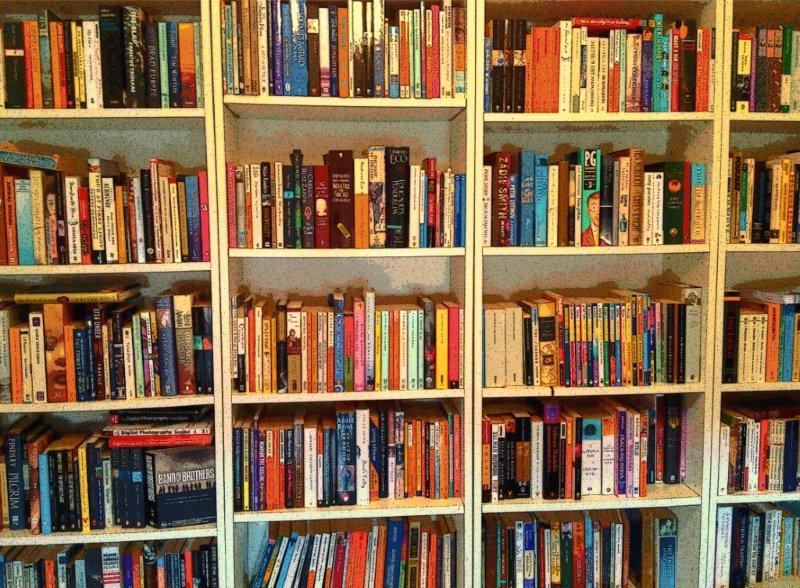
Needless to say, it took me a long time to arrange my shelves and I'm surprised Bibliohubby didn't run for the hills when he had the chance, as the revelation of my very specific form of OCD pre-dated our wedding and the birth of our first child (he was only Bibliofella back then). Having finished my massive project, I would then tweak it every now and then, pulling out a book here, re-inserting it there. My shelves were a source of immense pleasure - in fact, an image of those very shelves form the background to this blog and they can be seen in all their organised glory here:


I even used to ensure that the spines of the books were all lined up uniformly, but ever since Iggy, my son, has grown old enough to crawl and then walk, my precious approach to the shelves has disappeared. They now look like this:


Unfortunately, as we were already starting to pack up our house for an impending move when I took this shot, I haven't been able to show you a broader view, but even here you can see that the shelves are littered with: two packets of baby wipes in case of dirty hands, mouths or bottoms in the living room; two printed copies of the draft manuscript of my book; a pink dummy (pacifier); two framed wedding photos and various other things that are too precious for little hands; a small pile of children's books for easy access if the mood strikes.

What you can't see is the gradual process that led to my use of bookshelves as storage space for things other than books. You can't see the process by which first the bottom shelf, then the second and eventually the third was decimated by my son as he grew taller.

First, he enjoyed pushing all of the books into the shelves towards the wall so that the spines were no longer lined up. But then he discovered it was way more fun to actually remove the books from the shelves. Here is a photo of Iggy finding his literary soul:


After the 134th time he did this, I decided it was more trouble than it was worth to put the books back in any sort of order. Bibliohubby and I took to shoving the books back in randomly, wherever they fit. And so it was that Gabriel Garcia Marquez ended up next to Naguib Mahfouz, Dostoyevsky next to Freud, Rushdie's The Ground Beneath Her Feet alongside Drabble's The Peppered Moth. And, astonishingly, I didn't really care. I even quite liked the juxtaposition between the militantly organised upper shelves, those he could not yet reach, and the absolute jumble of the bottom ones.

As Iggy grew older and developed a serious fascination with cars, we started keeping large tupperware containers in the living room so that we could quickly toss the end-of-day debris of randomly strewn toy cars into these when the storm had died down and we could enjoy some rare adult time, too precious to waste on tidying properly. I started pushing the books on higher shelves back towards the wall so that the tupperware containers could sit in front of them. That's when the shelves' secondary purpose as useful storage space suddenly became apparent - to me the Mother, not me the Book-Nut.

And so, eventually, we ended up where we are today.

In my BC (before children) days, I never would have guessed that I would one day happily toss aside my literary OCD.  But in those days I probably hadn't considered that it would come down to a choice between hanging on to fastidious order and making it through the day with my sanity still intact. Lucky for Bibliohubby, sanity won that argument (though I'm not sure he would always agree with me on that count!).

Of course, as I pack up my books now and sadly contemplate several years before me in which I won't see them at all, in any kind of order (more on that later), I find myself promising that when I get to unpack them again one day, in a new house, I will do so with all the obsessive vigour I first showed in our current home. Maybe by then we'll be able to afford a house with a spare room I can use as a library. And maybe by then the kids will be old enough to pull a book down from the shelf only when they're interested in actually reading it.

Monday, July 15, 2013

Curtis Sittenfeld - American Wife

This was recommended to me as a good read, and between feeding a newborn, dealing with my toddler son's temper tantrums and preparing for a move overseas, I really needed a good read. I had never heard of Curtis Sittenfeld, even though her first book, Prep, was nominated for the Orange Prize. And I would not have been drawn to this book had it not been recommended - especially after hearing that it is based on the life of Laura Bush. George W is not my favourite person in this world (massive understatement), and I am not particularly interested in his family, either.

But American Wife really is a good read, albeit a long one. Sittenfeld writes in the first person from the perspective of a woman who grows up to become the First Lady of the United States. The vast majority of the book focuses on the relatively normal childhood and early adulthood of Alice Blackwell (nee Lindgren), but it is a titillating set-up: regular small-town girl ends up married to the President. It's like a great make-over story, and I'm a sucker for those.

But I had one major problem for most of this book: I did not like the protagonist. The narrative is easy to read, it washes over you like a summer rom-com, which is probably what kept me pushing through even when I became intensely annoyed with Alice. She is such a cloying goody-two-shoes, it irritated me to no end. For much of the book she seems to have no back-bone, no spunk. I know she is supposed to be a product of her time, and of her small-town upbringing, but I found her to be so wet at times that I almost threw the book across the room, willing her to stand up for herself. She is not my kind of woman at all, and it frustrates me that (if there is any truth to this story at all) a woman like this could become First Lady. Indeed, that a man with the potential to hold such an esteemed position would be attracted to a woman like this. And that his family would deem her suitable for him. But I kept reading in spite of these irritations because the story was good and I really wanted to know what happened next, even though I kind of already knew. I wanted to see how it would all develop, layabout Charlie becoming the President of the United States. It seems so unlikely, when his character ss first introduced. And in spite of myself, even though I was picturing Charlie as George W (I couldn't help it!), I became quite intrigued by him. I could even kind of see that he might have some personal charm about him, although obviously his political prowess leaves much to be desired, even in fiction. For example, Alice describes him as being lukewarm on the actual politics of being president: "Being president is for [Charlie] like taking a ninth-gradfer English test on The Odysser, and he's the kid who did most of the reading, he studied for an hour the night before, but he's not one of the people who loved the book." Instead Charlie is described as being in it for the power, and because he is concerned about his personal legacy.

In the end - minor spoiler alert - the whole story really is a lead-up to the moment when Alice finally does grow a back-bone, and this is what saved the book for me. There is a hint to this in the prologue, but I must admit it was lost on me until I returned to the prologue having turned the last page. When I did finally put the book down after coming to the end, I finally understood what Sittenfeld was trying to do with American Wife. For most of the novel I had been lost as to why she had felt compelled to write this. Was it just because the premise was fun? Like a high school reunion novel, where the protagonist makes it HUGE on the world stage before returning triumphantly to the place where she grew up? But if that was the case, why choose a real-life first lady to base this on, why restrict oneself so? Or was the motivator a peculiar fascination Sittenfeld has with Laura Bush herself? But if this was so, why choose to re-create in fiction a life that has already been thoroughly examined in biography?

In the last part of the book, when Charlie has finally made it big - you know, as the most powerful man in the world - it finally started to become clear. Sittenfeld is as critical of George W Bush as I am. This is not clear through the majority of the novel, which portrays him as a magnanimous, fun guy who is misunderstood and (perhaps) underestimated by his own family. But what Sittenfeld seems really interested in - and it is innately interesting, I'll give her that - is the question of how complicit a wife is, how much she can be held accountable, for her husband's actions. I think we are meant to dislike Alice, as I did, when she turns the other cheek every time someone does her wrong: when her best friend drops her for a negligible friendship misdemeanour; when a boyfriend treats her badly and speaks ill of her. What is most frustrating is that while Alice is a push-over, she is not stupid. She acts deliberately, intentionally letting things go. And Sittenfeld wants to know: when someone like that does not speak out against things she knows are wrong, can she be held accountable for the consequences of that decision to remain silent? Specifically, can a wife be held accountable for what her husband is doing, if she has known all along that it is wrong? When she does not object and instead sits idly by, supporting her husband, while he conducts himself in a way to which she is deeply, morally opposed - are the consequences of his actions not then her fault as much as his?

Charlie, like George W Bush, starts a war when he is President which is wildly unpopular with large factions of the population. He must deal with protestors and detractors, and Alice tells the readers (we are treated like a dear diary) that, in her view, he only persists with the war because he is too humiliated to back out of it - even though thousands of American boys continue to be killed. She tells us this in the same affectionate tone she reserves for Charlie throughout, and even though we know she does not agree with his stance on the war, it is difficult here to forgive her for her silence, and for her continued support of Charlie.

In introspective moments Alice contemplates her own position on the page, asking at what stage and how should she have acted.

"All I did is marry him," she asserts. "You are the ones who gave him power."

Should she have refused to marry him, way back when, because even then their political views were not aligned? Should she have prevented him from running for office? Should she have left him when he did, even though they had a child together and were in love? It's a tricky question, and Sittenfeld's exploration of the issues involved is interesting. Nevertheless, I can't believe that the answer is the one Alice proposes - that every marriage contains some degree of betrayal, of treachery, and that in keeping silent, and in secretly taking active steps against her husband she is just acting like any other American wife.

But the Alice we ultimately get to know is far more treacherous than we are led to believe for most of the book, and that at least made her more interesting to me.

Overall assessment: 3 out of 5. A good read, light but with some thought-provoking passages.


Saturday, July 6, 2013

Bookshelf porn

I have always dreamed of one day having a library. It would be the room where I sit and read, the room where I write at my desk, a room with the walls lined in floor-to-ceiling shelves, with all of my friendly books looking down on me. A room where I could spread out the books I am reading, the books I am referencing, the books I wish to browse through. A room scattered with throw cushions and rugs and tea-cups, containing a comfortable couch, my leather reading chair and many, many lamps, preferably fitted out with a window seat complete with a cat curled up into a warm ball. Sometimes, when I dream of this room, I wonder what the shelves containing my books might look like. And then I browse Google and drool over the many wonderful pictures of rooms just like the one I wish for. It's bookshelf porn, and here are some gorgeous examples, for your fantasising pleasure:


For those lacking space, but rich in renovation funds: why not try shelves set into the staircase itself?


Creative bookshelf design. I love the look of it, but am not sure it would allow for easy browsing.


Such gorgeous, spacious shelves! Though I am afraid this room would lack the cosy feel I require in my library.


I love this idea, for a house with a gabled roof and a library set in the attic.


Instead of a shelf built into the stairs, how about shelves occupying the (generally useless) space underneath the staircase? Fantastic idea!


Oh, I love this. If my room had shelves like this on each wall, I would be satisfied. The colour of the couch, though, leaves something to be desired.


Lovely down-lights on these floor-to-ceiling shelves.


What an innovative idea! Shelves in the ceiling, for a room with limited space. Too small for me, though, and access to the books would be difficult.


A bookshelf ladder like this is something I have always wanted. I like the thought of climbing up my shelves, visiting the books placed up high. 


Oh how I love these shelves! But why the curtain? In my room the shelves themselves will be the feature.


What pretty lamps on these shelves! 

I hold the vision for my own library in my mind's eye. What does yours look like?

Monday, July 1, 2013

Sheryl Sandberg - Lean In


It might seem odd that I would choose to read this whilst at home, on maternity leave, spending most of each day nursing a tiny baby. In fact, it was yet another bookclub pick - thanks Bibliofillies! - but it is also a book I've been curious about since it came out, even though I am rarely drawn to non-fiction. And actually, I think now is the perfect time to read it. Maternity leave is a wonderful time for reflection and soul searching. The experience of bringing new life into the world, of taking a break from your career and spending time at home, focusing energy on the physical task of nurturing young children rather than the intellectual tasks of a workplace, puts everything else in your life into perspective and allows you to observe it more objectively.

I will come right out and say it: I am a feminist. I make no apologies for my use of a word that has garnered all kinds of (largely undeserved) negative connotations. I believe in women making it in this world - however they choose to define 'making it'. This is even more true, and more poignant, now that I have a daughter. I loved Sheryl Sandberg's infamous TED talk (find it here), but a friend of mine, one of the Bibliofillies, was not impressed. "Nothing I haven't heard before," she commented. Nothing new. And fair enough - Sandberg draws heavily on statistics and case studies, so yes, most of the facts she presents in her talk, and in more detail in Lean In, are not new. But somehow the way she puts it all together, her collation of information, the simplicity of her message when she boils the facts right down - to me, it sounds fresh. It has made me re-think a few things. In fact, I have found it the most inspirational book on women in the workplace that I have ever read.

After several very bad experiences in law firms, and after watching Australia's first ever female prime minister get hammered by the press, I had decided I never wanted to make partner in a law firm, I never wanted to be general counsel of a corporation, and in fact I never wanted to make it to any public leadership position. It's not worth it, I thought. Success of that nature would require me to fight every day of my life against particularly nasty individuals who believed I had no right to be doing what I was doing, because I am a woman.

But Sheryl Sandberg has made me sit back and rethink this. That was the wrong message to take away from those experiences, I now realise. I am a woman with a certain degree of intelligence and privilege, who has obtained a number of undergraduate and postgraduate degrees. For any woman, but especially for women like me, who have had opportunities thrust at them, shying away from leadership positions just because the road might sometimes prove hard is not the right thing to do. With opportunity comes responsibility. And to turn down opportunity because of a perceived systemic bias against women gives the wrong voices too much power. It ensures that the culture created by those voices will continue to dominate. It does other women no favours at all.

The first chapter of Lean In is subtitled What Would You Do If You Weren't Afraid? This hit me, hard, because of course, without realising it, I was charting a course steered by fear. Sandberg points out that:

"Fear is at the root of so many of the barriers that women face. Fear of not being liked. Fear of making the wrong choice. Fear of drawing negative attention. Fear of overreaching. Fear of being judged. Fear of failure. And the holy trinity of fear: the fear of being a bad mother/wife/daughter."

She recounts a speech to female University graduates in which her advice was that as they started their adult lives they should "Start out by aiming high." And of course we should - all of us should, male and female.

In the following chapters, Sandberg parcels out succinct pieces of advice, often using her personal experiences to illustrate the authenticity of that advice. She recounts a story of women attending a meeting who chose to sit on the chairs lining the side of the room when there were insufficient places at the conference table for all attendees, rather than confidently grabbing one of those spots for themselves. Sandberg points out that this behaviour did not help those women with how they were regarded in the workplace, it did not create an impression of competence or equality. She says that we should always feel confident enough to sit at the table - both literally and figuratively - rather than take a back seat out of misguided notions of diplomacy or benevolence.

She talks about using our natural qualities so that they work for us rather than against us in the workplace - we don't have to be liked by everyone, but also we don't have to behave like men to get ahead (she even says it's ok to cry at the office). And one of my favourite pieces of advice in Lean In is to think of your career as a jungle gym rather than a ladder. It's rare for people to start down one career path and follow it linearly, through promotion after promotion, until they ultimately reach the pinnacle of their profession. It's more likely, Sandberg says, that success will come from looking more flexibly at one's career, from being open to opportunities even when at the time they may seem like sideways moves. A jungle gym, not a ladder. And isn't this realistic, these days? It is no longer the case that people who start out at one company then stay with that same company until retirement. Things have changed, opportunities might come from the most unlikely places. Sandberg also suggests that the right career choices inevitably move with the market: pick the company with the highest growth. Follow market growth, Sandberg says, even if the role seems less significant, and your career will grow too.

More practical advice from Sandbrg is to be honest in the workplace, to speak up truthfully even if it is easier or seems more diplomatic to remain silent or to sugar-coat something, and to seek the same honesty from your co-workers, even if it's hard to hear some of the truths you thus invite.

And the key career advice from Sandberg, the heart of the book: don't start leaning back from the workplace in preparation for a life you may one day lead, before you are actually leading that life. Don't make career decisions that take into account the baby you have yet to fall pregnant with, the husband you have yet to meet. I feel ashamed to admit that I am guilty of this. When I was seriously considering making a significant change in my career, had indeed taken several steps down that path - several successful, exciting steps - I let some advice I received influence me and I decided not to follow that path after all because doing so might interfere with my ability to meet someone and start a family during my thirties. Now that I have my family I don't regret the decision I made, because had I behaved differently back then my life now would surely be different too. But certainly I regret having made a decision to lean back from my career before I really needed to. I don't think that was the right basis for my decision. I'm sure that, had I followed that career path, I still would have eventually found a way to create a fulfilling family life.

The advice in Lean In is compelling because Sandberg herself is a woman who has clearly succeeded at the highest level. In the latter chapters of the book she talks about how it was possible for her to achieve this professional success while raising children, and the answer lies in her domestic set-up. It is most important, says Sandberg, to ensure your spouse is a true partner - someone who contributes equally to your family. When looking for a life partner, she says, her advice to women is "to date all of them: the bad boys, the cool boys, the commitment-phobic boys, the crazy boys. But do not marry them. The things that make the bad boys sexy do not make them good husbands. When it comes time to settle down, find someone who wants an equal partner." She cites statistics that I found most interesting, indicating high levels of happiness for women who juggle multiple roles, as long as they have support at home, and which also show that children benefit enormously - thrive, in fact - from having fathers who are genuinely involved in domestic duties. Of course, finding a partner like this might be easier said than done, but Sandberg's point is that women should insist upon it. Only by doing so is it likely to become the norm. Men, she says, must learn to 'lean in' to their domestic lives, just as women must lean in to their professional lives, accepting opportunities and achieving leadership positions. Only then will it gradually become as acceptable for women to hold the top jobs - in politics, corporations, and so on - as it is for men.

For Sandberg the concept of 'having it all' is "the greatest trap ever set for women." It is intended to be aspirational, says Sandberg, but in fact it makes us all feel bad. She says that the very concept "flies in the face of the basic laws of economics and common sense... it is best regarded as a myth." She says that the more pertinent goal is doing it all, and even that is an impossibility. Women with both careers and families worry continuously about measuring up (no one needed to tell me that!), but Sandberg says that we measure ourselves against the wrong yardsticks: "we compare our efforts at work to those of our colleagues, usually men, who typically have far fewer responsibilities at home. Then we compare our efforts at home to those of mothers who dedicate themselves solely to their families." And on and on - we compare our bodies to those who are paid to dedicate themselves solely to looking a particular way (models, or athletes). She quotes Gloria Steinem, who famously said: "You can't do it all. No one can have two full-time jobs, have perfect children and cook three meals and be multi-orgasmic 'til dawn... Superwoman is the adversary of the woman's movement." I know all of this, I have heard it before, but isn't it something we should hear again and again?  As I sit here writing, I am also jiggling with one foot the baby rocker in which my seven week old daughter lies. I have gotten up intermittently during the writing of this post to tidy a room, start preparing dinner, and put away the laundry my husband has folded, all the while calculating the hours left until I need to pick up my 20 month old from daycare, where he spends two days a week. I have kept the computer on in front of me whilst trying simultaneously to get some reading done of our new bookclub book, and checking Facebook and my email each several times, when I am actually trying (in and around the writing of this blog) to finish writing cover letters and a synopsis of my book so that I can submit it to publishers. I managed to get a run in this morning, but am still unsatisfied by my post-pregnancy weight (although at seven weeks postpartum I don't know why I am putting this pressure on myself). I want the house to be perfect before our landlady inspects tomorrow, I want to give my daughter a bath, I want to have dinner sorted for my son before he gets home this evening (and I want him to eat it!) and I want dinner to be prepared for myself and my husband by the time I put my son to sleep later tonight. Mainly, I want to post this before today is over. And all the while, I am fitting in the regular feeds Lulu requires, which become ever more frequent as evening approaches. Of course I am falling short on all counts. At night, when I get up to breastfeed Lulu, I will also be trying to get some reading in on my Kindle, but my brain won't be up to processing much; and when I get back into bed, my brain will be just active enough to keep me awake worrying about everything: how much more there is to do for our move overseas later this year, my lack of progress on the next book, whether the kids are each getting enough attention, whether my son is eating a balanced enough diet and getting enough stimulation, about my parents, about our finances... the list is endless. All this and I'm not even working at the moment (though this, of course, is yet another cause of stress). All this and I am one of the lucky ones - I have help, and I have a true partner in Bibliohubby.

We cannot have it all, or do it all, at the same time. It should be a mantra women repeat over and over to themselves. Sandberg cites Nora Ephron (RIP, smart, funny woman), who, in a 1996 commencement address, said: "It will be a little bit messy, but embrace the mess. It will be complicated, but rejoice in the complications. It will not be anything like what you think it will be like, but surprises are good for you. And don't be frightened: you can always change your mind. I know: I've had four careers and three husbands." Sandberg says that at Facebook one of the posters up on the walls says "Done is better than perfect." And she stresses that what we need to lose, all of us women, is GUILT. That tricky, pervasive mother guilt that afflicts us all. Sandberg says that "guilt management can be just as important as time management for mothers." She says that while she looks at the number of nights spent away from her children and berates herself for this failure, her husband celebrates the fact that they eat dinner together as a family as often as they do, and that these conflicting viewpoints are indicative of our problematic and counter-productive female guilt. But she also says that it can be fun when our various roles collide - when we bring our children to the office and they get to see where we work, for example. She says Facebook is family-friendly and it was a positive thing for both her work and her family life that her kids got to know her colleagues. I agree - I remember as a child visiting my mum at the clinic where she worked as a doctor, and I remember how normal it seemed that she was on call several nights a week, and might disappear at midnight without notice. My mother says that when she stopped working, I said to her (in all my youthful wisdom): "But you've been a doctor as long as I've known you!". I grew up proud of my mother, not at all concerned by the number of hours she was away from the house. Of course, I was lucky to have a father who stayed at home longer in the mornings to prepare our breakfast and pack us lunches for the day before going to work himself. This meant he got home later at night, but my mum got home earlier - that's how they balanced it. And that is Sandberg's point, too - we have to decide what's important to us and then find a way to make that happen, and be ok with letting the rest of it go. We need to find what works for us. She points to a Stanford professor's research which shows that setting obtainable goals is the key to happiness. Striving for perfection is not (again, I'm not sure why it require Stanford level research to prove this!).

Sandberg says that many women shy away from talking about all of this, especially the bits about the difficulties of being a woman in the workplace and being a feminist, because they perceive that it will do them a disservice to raise it and to be seen as 'one of those'. But the point she makes, with which I wholeheartedly agree, is that the reverse is true: the only way to effect change, and to work with other people (not just women) to create that change or even just to get through it all in good company, is to talk about it. It's been said before, but feminism is not a dirty word.

Everyone will take different things from this motivational read, but these are my take-home points: I should not be afraid, any longer, to succeed at work, I should grab opportunities even if they come out of left field, I should rely on my husband to be a true partner, I should be ok with achieving some goals, the ones I set for myself, and not others, and, above all, I should embrace the mess. 'Cuz that's life.

Overall assessment: 4 out of 5

Pros: This is without question the best book I have read about working mothers. Note, however, that this is not necessarily saying a lot - I don't read a lot of non-fiction and I hardly ever read self-help, though I'm not sure this book fits into that category. I do read feminist writing, though, and I think we can safely categorise this as a feminist text for our generation's working woman. Aside from the fabulous Caitlin Moran's How to be a Woman, and my idol Tina Fey's Bossypants, this is the most influential feminist read I have picked up in a long time.

Cons: This is a book for working women. Parts of it - particularly the partnership chapter, and the chapter on the myth of doing it all - will also speak to women who are stay-at-home mums, and Sandberg is sympathetic to any choice a woman makes for her life. But really, the readers who will get the most out of this are working mothers. Also, even though I am (most of the time) a working mother, my choices are different to those that Sandberg has made. When I read about her decision to willingly sacrifice being present at all of her children's dance recitals and parent-teacher conferences and so on, it initially made me uncomfortable. But when I kept reading I recognised that she is not calling on everyone to make those same decisions - they are simply the ones she has made for herself and her family. And all of us have that choice to make.

Saturday, June 22, 2013

Carrie Tiffany - Mateship with Birds

The inaugural winner of the Stella award for Australian women's writing, and this year's winner of the NSW Premier's award, I picked up Mateship with Birds because it was a recent bookclub read (for my second bookclub; we have yet to pick a name for ourselves). I hadn't heard anything about this book when it was first suggested, nor had it yet won the prizes (though it was shortlisted for the Stella). I'm glad it was our pick last month, though, because I don't think I would have read it otherwise and I really enjoyed it.

This is a very Australian novel. I would recommend it to my North American and European readers because it will be unlike anything you have read before (unless you have read Tim Winton or Patrick White), and to my true-blue Aussie readers because parts of it will resonate with you, especially if you have family in the country.

I have a very particular way of describing Australian books that are set in the bush - and that is 'dusty'. This is one of those dusty books. One can feel the characteristic red dirt being kicked up around one's face in the dry heat as one reads. And hear the Kookaburras and Magpies. Tiffany's beautiful writing is incredibly evocative, calling to mind the unusual countryside of Australia and the slow pace of life as it unfolds on the land. For me personally, because I did not grow up here, I don't get a familiarity or true emotional resonance from Tiffany's writing - but I do enjoy reading about the dusty red centre of this unique country.

This is, on the surface, a relatively quiet book centred around the relationship between Harry, a milk farmer and Betty, a nurse, in conservative 1950s rural Victoria. Betty works for an aged care facility in town when she is not busy looking after her two children, Michael and Hazel. As a single mother, Betty has been scorned by the townspeople since she arrived many years earlier, and she leads a calm, lonely life. Harry, who lives on the neighbouring farm, is her only true friend. He too seems lonely, turning to Betty for home-cooked meals, companionship and the unexpected joys of standing in as pseudo-father to Betty's children.

Yet in spite of years of apparent courtship, the friendship between Harry and Betty has never developed beyond the platonic. The 'mates' (friends) have never become mates in the sexual sense - this is one of the quintessentially Australian puns hidden in the title to the book. The other is the play on the use of the Australian vernacular 'bird', which is slang for woman, and also refers to the animal, which features heavily in this portrait of life on the land. Harry's hobby is bird-watching, and he follows with sweet affection the lives of the Kookaburras living on his farm. He keeps an unassuming diary of their goings-on, which he writes in blank verse, and excerpts of which are interspersed throughout the novel. At one point Harry speaks of being able to assess the size of a farm or estate by the size of the Kookaburra family living there, an indication of how closely entwined are the lives of animals with the lives of people in this area of the world.

With the focus on Harry and Betty, one could see this is in some ways as a love story, albeit a very pragmatic one. But it is also, essentially, a story about life in the country, and not just the lives of people, but also the lives of animals. And when I said above that this is only ostensibly a quiet book, that is because beneath the surface, this is a book seething with fertile activity. Although it is absent (for most of the book) between Harry and Betty, sex in all its forms permeates the novel - from the fertilisation of Harry's cows, to the lives of birds and sheep and other animals on the land, to the bizarre tendencies of fellow farmer Mues and the budding sexuality of Betty's children - everything in and around the farm and the earth is seen to be teeming with sexuality in a base, quotidian way that is both reassuring and troubling. One of the girls in my bookclub found that she was unable to enjoy the story as it unfolded because she felt it was overshadowed by a sense of ominousness created by the overt sexuality. I think, though, that the in-your-face fecundity of the landscape can be explained by Tiffany's desire to illustrate how ubiquitous sex is in the country, and how people are really no different to animals. In urban settings one can perhaps mask, or hide, from the sex that is inherent in most of life's activities - one can infuse it, instead, with the human construct of romance, thus disguising our animalistic tendencies. But in the country, Tiffany asserts, our base qualities are almost impossible to avoid. Milk is not produced by non-lactating cows, and lactation is caused by fertilisation. Families of birds don't grow and survive without mateship rituals. Even death is sexualised. Survival, life, sex, death - all of these are part of the same cycle.

In the midst of all this, then, there is not much room for romance. Harry and Betty are clearly close, and they are likeable - both burrow their way insidiously into the reader's heart. I found myself warming to Betty when Tiffany described the way she used her lunch hour to change out of her nurse's uniform and into stockings and a hat in order to visit her elderly dementia patients disguised as their wives, bringing a little joy to their otherwise drab existences. I warmed to Harry when his dedication to Betty's children became clear, through repeated acts of paternal protection and kindness. However, both are such quiet, socially withdrawn personalities, that without a severe interruption of some kind the line between friend and mate might never have been crossed.

I won't give away the ending, even though this is hardly a plot-driven novel. I will say that I found the book moving and rather sweet, in spite of Tiffany's effort to keep the central relationship so pedestrian.

Overall assessment: 4 out of 5. I enjoyed this and read it quickly.

Pros / favourite parts: The writing is beautiful. Many of the passages are absolutely lovely, and these stand out starkly against the brutal reality of the descriptions of life on the land, a contrast that I'm sure was intentional.

Betty's son Michael, on why it is he will one day choose to be a farmer - "He heads out across Foot Foot's paddock towards Harry's and has the sensation that he's walking back into himself. That the day at school - lining up on the asphalt quadrangle, scuffing his shoes on the wooden floors, leaning against the concrete toilet block to smoke at lunchtime - has been a kind of skimming across surfaces; that he's moved through the day without ever putting his weight down. Here, walking across the paddock, he feels his ankles soften to take account of the uneven ground. He picks his way through the clumps of cape weed and over the mounds of dirt left by the plough. There's a rhythm to it. A way of placing your feet so they are receptive to the ground beneath. In two years' time he'll have a bitter argument with his mother about a clerical traineeship in Swan Hill and he won't be able to explain to her why it is he wants to farm."

There is a section, too, describing Harry as a little boy, entranced by the cuckoo clock on his parent's wall. One day, when they are away, curiosity gets the better of him, he finds he can't wait any longer for the little bird to appear, and he stands on a chair and removes the clock from the wall and dismantles it to discover the cogs and springs within: "At the very bottom of the clock case, in each corner, is a leather bellows. Harry pushes one of them with his finger and it makes the second half of the cuckoo sound, but with a puffed sigh at the end. The lungs of the cuckoo bird are not inside the bird itself. They are just a mechanism within the clock. The cuckoo clock is an act of ventriloquism; a callous device - the mute bird skewered to the thrusting arm - forced hour after hour to repeat its trick." This discovery upsets young Harry to the point of tears: "He thinks he might as well cry now, the crying will have to come. There will be the disappointment on his mother's face and his shame at that. But there's something more, too. He feels like he has lost something. He tries to slow his breathing now, to slow everything down, to give himself more time, but the tears have made his nose run and he's having to suck great gulps of air in."

I just love that passage. Watching my small son every day I can see his joy at experiencing things for the first time, his belief in the wondrous nature of the world. And as his mother, I so desperately want to protect him from the disappointment that inevitably comes from realising that the world is not as magical as one thinks. Tiffany's writing here so perfectly and poignantly conveys this moment of recognition for small children - it shows quite remarkable insight and sensitivity.

Cons: I do think Tiffany sometimes goes too far in her effort to portray the baseness of the sexuality in the countryside. I don't think all of the grotesque or ominous scenes were necessary - and as a city dweller myself, I found myself a bit squeamish at times, though I suppose that's the point.

Wednesday, June 19, 2013

The Art of Linguistic Expression


I was watching a video online the other day, of Jeanette Winterson interviewing A M Homes, in which both authors agreed that people no longer cared about the quality of writing in a book. One of them, I don't remember which, suggested that use of language was never mentioned anymore when a new book was reviewed, and the other nodded vigorously in agreement. Both authors felt that the new generation of readers didn't seek out high-level linguistic expression in books, and they attributed this modern lack of interest in the quality of writing to the internet era - to text-speak and emoticons, to acronyms and abbreviations.

I found the whole thing peculiar, because whilst I acknowledge that there is a generation currently developing into adulthood who communicate largely through informal means, where the rules of grammar are less important than the speed of getting a point across, I haven't seen evidence yet that this has been translated into the world of literature. I read a lot of reviews, and the focus of these seems much the same these days as it always has been. Similarly it seems to me that the use of language is as important as ever in deciding who should win a literary prize.

Of course the existence of new technologies has changed modern literature in some interesting ways - for example, the chapter in Jennifer Egan's Pulitzer Prize winning novel A Visit From the Goon Squad which is written entirely in Powerpoint could not have existed fifteen years ago, and there have been a number of other books (like 'e' by Matt Beaumont, an epistolary novel written entirely as a string of emails between workers in an advertising agency, and Hold the Fries by Nina Schindler, which is told exclusively through letters and text messages) that make a strong feature of new technologies. But in my view a really good book (including the ones mentioned above) is still one which combines beautiful writing with remarkable story. And I truly don't believe that the text-generation will do away with lyricism, or clever use of vocabulary, or spare but stunning prose.

Maybe I am being optimistic. But I think it is far more likely that Homes and Winterson are being unduly pessimistic. Every generation feels the next spells the end of what matters. And inevitably, that next generation simply introduces change to the existing order - not on a grand scale, but
on the same incremental level as the change wrought by the generation before. Change is not a bad thing. Organic beings are defined by constant change. That's what it is to be organic. Change is growth.

And language, like human beings, is in a state of constant flux; it's like a living organism. Those of us living in the English-speaking world are perhaps less aware of this fact than people in some other cultures, because English is the official language in several countries. In some non-English speaking nations formal linguistic change is more obvious. For example, Germany has formalised the process of updating the national language in a way that has a very real influence on spoken German. An official committee meets regularly to discuss whether a new word should be adopted into German from slang, or from another language, due to regular usage, or whether an existing word should be dropped, or even whether a spelling or a grammatical rule or a Germanic oddity has reached its use-by date. When I grew up in Munich the 'Eszett' or 'scharfes S' still existed - a letter that looked like a capital B on a stick, which denoted a sharp 's' sound. Several years ago it was decided that this should be dropped, and now two S's in a row are used instead to create the same sound. The change was announced, and almost immediately it took effect across the nation.

The English language, too, has official committees devoted to guiding the way our language evolves. In the UK, for example, the Queen's English Society fills that position. But generally those of us who reside in the 'colonies' are unaware of the decisions reached by that Society. Certainly I can't remember ever being aware of an 'official' change occurring in the English language from one day to the next. For conversational English, evolution is largely informal - although the introduction into Urban Dictionary and even the eventual adoption by the Oxford English Dictionary of new English words does indicate that such change is eventually accommodated and embedded in a more formal way. As loathe as I am to acknowledge it, even grammatical errors that become common usage due to ignorance can, through persistent use, eventually become accepted parts of the English language. My personal reluctance to accept the use of 'but' at the end of a sentence rather than as it was intended, a conjunction between two parts of a sentence, does not mean that this abomination will not be regarded as a permitted use of the word in due course. And our objection to abbreviated text-speak does not mean that some of it won't ultimately find its way into the English lexicon.

Nevertheless, I truly believe that in literature, beauty and wit are still widely regarded as virtues. The concept or definition of beauty might change from generation to generation, but I think it is unlikely that the next generation will do away with it altogether. Even in hip-hop and rap music, pithy expression and a clever turn of phrase are admired. The fact that language, and the way language is used, has changed with the advent of the internet and the smartphone, with email and Facebook and Twitter, does not mean that readers have suddenly let go of what has always been one of the joys of reading - experiencing the exceptional use of language by one who wields it with unusual skill.

What do you reckon? Does language matter to you when you read? Do you prefer books where the writer has a particularly aesthetic approach to language? Or do you not care how an author expresses herself as long as the plot keeps you reading?


Tuesday, June 11, 2013

Edward St Aubyn - Mother's Milk

I feel complicated about writing this review. I have had such unadulterated admiration for St Aubyn since I started reading his Patrick Melrose series that I feel guilty for having turned to this fourth volume at a time when I was probably not in the right frame of mind to embrace it. The result, of course, is that I didn't enjoy this book nearly as much as I did the first three parts of the series. So I am willing to give St Aubyn the benefit of the doubt to some extent, by placing some of the blame for my critical reading on my mindset - but not all of it.

In this episode of Patrick's life, he is married, in his 40s, with two young sons. Unlike the first three books in the series, this novel covers more than a 24 hour period, and I believe some of the intensity that has characterised the books to this point is lost as a result. And whilst the series thus far has dealt primarily with Patrick's relationship with his father and the consequences of that relationship on the rest of Patrick's life, the central story of this book revolves around Patrick's relationship with his mother, Eleanor, her physical deterioration and descent into dementia, and the dissolution of Patrick's inheritance (which makes him very angry). St Aubyn illustrates the effect on Patrick of his mother's gradual demise by using a mix of narrative voices, all focused on Patrick and his actions, including Patrick's own first person voice. What is perhaps most jarring - but also most original - is that the book opens with first person narration by Patrick's first-born son, Robert, when he was a baby. And when I say baby, I do truly mean baby - in the first pages, Robert describes, for example, the feeling of being born:

"Why had they pretended to kill him when he was born? Keeping him awake for days, banging his head again and again against a closed cervix; twisting the cord around his throat and throttling him; chomping through his mother's abdomen with cold shears; clamping his head and wrenching his neck from side to side; dragging him out of his hone and hitting him; shining lights in his eyes and doing experiments; taking him away from his mother while she lay on the table, half-dead."

You can see why this highly original opening was difficult for me to read in the last weeks of pregnancy! Obviously this defies any kind of reality, and that's fine - by starting with such a bold example of false narration, St Aubyn signals to his readers that they should not necessarily expect the narrative voices in this book to be true to life. And I accept that. When Robert later makes astute observations that are easily beyond the wit of most well educated adults, a reader is capable of accepting this because the framework has been set up from the beginning - but as with all books that require such a suspension of disbelief, it must be executed with consistency. That consistency is missing here, and this is where I believe St Aubyn fails - or at least it is where he lost me. I couldn't accept that a child narrator who, on the one hand, is able to assert during the family's trip to America that French Fries should now be called Freedom Fries (and understands the political reason for this), who is aware when his father ruminates in front of him that "[Robert] wasn't being communicated with, but allowed to listen to his father practising speeches", and who has remarkable insight into human relationships - would also, on the other hand, behave like a young child and ask exactly the kinds of questions that one would expect of children in a new country ("why do the pavements glitter?"). As far as I was able to tell (given that my reading of this book, like my writing of this review, was punctuated by a toddler climbing all over me and a baby crying to be fed), Robert was aged between six and nine for most of the book.

A few other inconsistencies also crept into the text of Mother's Milk. The book is written with little regard for the existence of the previous volumes in the series. Patrick drinks heavily but makes no reference to his previous addiction. Indeed, his years of severe addiction are not referred to at all, which beggars belief in a novel that deals so personally with Patrick as a protagonist. I am no expert, but I would have thought it would be fairly problematic for a former drug addict to develop an addiction to another substance later in life - I would have thought the latter would raise all kinds of alarm bells in light of the former. I would particularly have thought that the visit of Patrick's friend Johnny, who was his partner in crime during much of his earlier substance abuse, would have raised a comment or two about their wilder days and their lucky escape from an early end. But no such comments were made, even while the two shared intimate conversation and a bottle or two of wine.

And in the penultimate sequence of the novel, Patrick's family takes a trip to America - yet his earlier time in New York City, where most of the second novel of the series, Bad News, is set, is not referenced once. In fact, the holiday is written in such a way that it could well be Patrick's first ever visit to the United States. Facts and oddities about the United States are shared as though the whole family was observing these as newcomers to the country.

A raft of inconsistencies indeed. So obvious did I find these that I wondered whether they were deliberate. Perhaps St Aubyn wanted this book to stand on its own? Certainly it does so successfully - this book alone, out of the Patrick Melrose novels, was shortlisted for the Man Booker Prize. And I suppose I was more attuned to notice such things than most readers, having read the first four books of the pentalogy in quick succession rather than as they were published, with a year or more in between. Maybe for other readers these things don't matter so much.

More troublesome for me than the inconsistencies, however, was Patrick's character. In book one, Never Mind, Patrick as a five year old child is endearing and pitiful, drawing heavily on the sympathy of the readers. For that reason, we forgive him for his behaviour in book two, Bad News - particularly as Patrick's horrid conduct in that book is fuelled in equal measure by his hatred for his father and a vitriolic self-hatred. By the end of book three, Some Hope, what we are left feeling is that there is indeed hope for Patrick - he has started to redeem himself, and for the first time I found myself liking him. So it was a huge disappointment in Mother's Milk, when one might assume that Patrick's redemption has well and truly arrived - marriage, fatherhood - to find him as an embittered, nasty middle-aged man engaged in casual adultery.

As I stated at the outset of this review, I did read this book at an unfortunate time. Late pregnancy and the first few sleep-deprived weeks with a newborn are not the ideal time to read a book dense with rich language and heavy on the darker side of cynicism. I read this very slowly. Once things had calmed down at home, I re-dedicated myself to the task of finishing Mother's Milk, and I must say that my enjoyment of it increased thereafter. It became clear to me, for example, that Patrick's adultery is a product of his wife's total absorption with motherhood - something that is claimed by Patrick throughout the book, but which at first I took to be merely an excuse. Early on, Patrick says that in picking a wife he was so concerned about choosing someone who would be a good mother to his children that he had neglected to find someone who would be able to juggle that task with continuing to be a good partner to him. And certainly one of his redeeming features here is his determination to be a good father, or at least to ensure that his children lead reasonably good lives - although St Aubyn doesn't portray him with any warmth, and we don't see him engaged in fatherly activities like tossing a ball around with his sons. His fatherhood mission is illustrated more cerebrally. Towards the end, for example, he says that he was obsessed with "stopping the flow of poison from one generation to the next, but he already felt that he had failed." Patrick is far from perfect, but his motivations are not without some merit.

Overall assessment: 3 out of 5.

Pros: As always, St Aubyn's language is impeccable. In spite of my reservations regarding inconsistency and character, I have found myself recalling parts of the novel after putting it down, and calling up quotes in my mind. The interminably sad portrait of Eleanor, Patrick's mother, will stay with me, I think (though I'm not sure that's a good thing!). And this book probably suffers from its necessary comparison with those that came before. I'm surprised that this is the one which was shortlisted for such a prestigious prize, but I am not surprised that, on its own, it was regarded so highly.

Cons: See above re inconsistency and cynicism.

Tuesday, June 4, 2013

The Future of Books: What of book sightings and signings?

Just over a week ago I posted a quote from a book called Judging a Book By Its Lover, by Lauren Leto. I now feel compelled to share another excerpt from that book, which is really a collection of witticisms and anecdotes about books and reading - from one book lover to others. It's a fun read, and my only true criticism of it is that Leto tends to be rather American-centric in her literary references.

I have written before about paper books ('real' books) versus e-books. Leto gives a compelling argument in favour of paper books that I had not previously thought of:

"There's a reason book lovers are the last ones to hold out in this digital revolution. Music and movie lovers have never had the same pleasure that book lovers have in being able to identify on sight a fellow fan of Tolstoy or Didion. What does the e-reader revolution mean for all of us who get a thrill from noting the book in a stranger's hands?

Music devotees meet other fans at concerts or by recognising concert T-shirts. Movie lovers will wait in line together at midnight for the first peek at the new Tarantino film. Readers, however, have it better; they carry around the objects of their worship and roots of their collective bond everywhere they go."

She goes on to point out that: "...in ten years, print books themselves may be a thing of the past. I fear as digital books become ubiquitous, the tradition of reading may remain as strong but the ability to sight fellow minds will be disintegrated. As book covers slip from hands and are replaced by plastic tablets, readers lose the wonderful, clandestine opportunity to quickly create a mutual understanding with strangers. Then what will we be left with? And what about other print traditions? If bookstores vanish, where will an author's book readings occur? And book signings? What will authors sign?"

Oh, this made me sad.

Most of us books lovers will have a story about seeing someone reading a book we love - on a bus, in an airport, on a plane - and connecting with that person, either entirely in our minds or in reality. I love that sweet moment when one is reading a book in public only to look up and find a complete stranger nearby reading the very same book. Often a smile passes between the two of you, a knowing smile, and to me that connection between strangers is a confirmation of humanity. It makes me warm inside, a feeling I might carry with me for the rest of my day. Other times that coincidence and symbol of similar interests is enough to spawn a conversation. Sometimes, through the haze of severe jetlag, I have enjoyed such a moment, perhaps after seeing someone reading a book by a favourite author, or reading a book I want to read, but have yet to pick up. Frequently, I will ask how my fellow reader is enjoying the book, and a conversation ensues which combats the boredom of a lengthy transit or a long haul flight.

The thought of these chance meetings disappearing fills me with preemptive nostalgia. But worse still: book signings. Author readings.

I have been going to these since my undergraduate days, when writers would come to the English department of the University I attended, and have sought them out ever since. With my mother, I saw Margaret Atwood speak at a theatre in Kingston, Ontario, when she was at her feisty best, and experienced for myself that quick wit and sharp sense of humour. I heard Michael Ondaatje speak in Toronto, alongside Anthony Minguella, soon after the film version of The English Patient was released. They spoke of the process of converting the book into the movie, how Minghella fell in love with the book and tracked down Ondaatje, how they collaborated to make the movie that would win the 1997 Academy Award for Best Picture. I heard another of Canada's great novelists, Timothy Findley, speak before his death in 2002. I attended an intimate bookstore reading by the beautiful Arundhati Roy after which I spoke to her and watched her face fall as I gave what I thought was a compliment:

"I like your style of writing," I said to her.
"I don't have a style," she responded, deadpan. I still remember the sound of her voice as she read from that incredible book, The God of Small Things.

In Sydney I heard the great Jonathan Franzen speak about Freedom, and met his handsome gaze afterwards as he signed my well-worn copy.

In fact I still have the signed copies of all of those books on my shelves. They are my treasured possessions. Someone once told me that they were wary of meeting the writers they loved in case they differed from expectations, in some discomforting way. But I have never worried about that. Writing and reading, when interconnected, become two sides of a rather intimate activity - these people, the writers, have already invited me into the depths of their mind. These are people I already know, in some way. I want to meet these people, more so than actors, who are playing a part when we see them on screen. And I have yet to be disappointed.

The thought of book tours and book signings disappearing along with paper books is just too much to bear. But Leto is right: where would Paul Auster sign his newest e-book for me? How would Salman Rushdie sign an electronic version of Joseph Anton? (even the thought of Joseph Anton in e-book form seems somehow sacrilegious)

So join me, please, and let us rage, rage agains the dying of the light.