Showing posts with label Patrick Melrose series. Show all posts

Thursday, April 4, 2013

Edward St Aubyn - Some Hope

I hope this isn't too boring for all of you. Once I find an author I like, I can be like a dog with a bone - I like to read through a number of their books immediately,  until I am familiar enough with their work to know if I will want to buy the next-released book as a matter of course, or whether the book I read first was a stand-out anomaly. So I emerged from Edward St Aubyn's explosive Bad News and turned immediately and greedily to his next Patrick Melrose book, Some Hope. I do promise that I will pick up a different writer next, to prevent this blog from becoming exclusively St Aubyn-themed!
This novel opens on Patrick Melrose in his 30th year. I now feel that it would be accurate to describe at least the first three parts of this five part series as the story of Patrick and his relationship with his father. Although his father is dead by the time the second novel begins, the personhood of Patrick throughout his life is obviously shaped by his feelings about his father. In this third instalment, we see Patrick clean, after successfully battling his addictions through numerous stints in rehab, still miserable, trying to find a way somehow to make peace with his dead father so that he can move on and, perhaps, find a way after all to live a useful life.

The backdrop to all of this internal strife is the gathering of various guests for a grand party at a country estate, in honour of Princess Margaret. St Aubyn here returns to the omniscient third narrator he used in Never Mind, and again uses it with wild abandon - the first half of the book leaps around to so many different characters that I found it quite difficult to remember who was who, and started wishing I had kept notes to remind myself. I actually think this would have helped my reading. As it was, I read this far more slowly than I did the first two books, with less absorption. But in the end it didn't matter - eventually the plot coalesced and the description of the party itself is a riotous read, rife with the colourful depictions of grotesque English upper-class arrogance that were so successful in the first book of this series. Really the success of these books is the ability St Aubyn has of defining and commenting so astutely on an entire class and country of people whilst keeping readers meanwhile occupied with the intriguing but smaller story of just one member of this class. As it stands, the Patrick Melrose series is a scathing indictment of the British upper class and what it represents, and how archaic, ineffectual and irrelevant it now is. In this book, St Aubyn flirts with controversy by including royalty in his critique. Princess Margaret is painted as a fatuous, mean-spirited megalomaniac - not very different from many of the other attendees at the party - and I felt as I read the account of her that St Aubyn had probably got it spot-on.

At times while I was reading this I thought nothing much was happening - but then I finished it and realised that actually tons had happened. Patrick determines that perhaps one way of dealing with his past is to be truthful about it, to talk about it, and he takes the giant step of confessing to his great friend Johnny Hall what happened to him as a child. Whilst this doesn't immediately heal all, it does help Patrick realise that forgiveness, something that has been eluding him for years, might not be necessary after all; perhaps a simple acknowledgement and acceptance of the person his father was, and of what had shaped him, was enough. Various characters from the previous two novels in the series return, some quite surprising. Bridget, who was a pretty but common girl brought along to France as the sexual plaything of the contemptible Nicholas Pratt (and so he is) in the first book, reappears after a society marriage as the hostess of the chic party central to Some Hope. Her husband, Sonny Gravesend, has been having an affair that everyone knows about and which will come to a head at the party itself. One of Patrick's acquaintances from the drug years returns in a very unexpected cameo. And the French ambassador to England has an embarrassing and very public moment when he accidentally spills sauce from the dinner he is eating over Princess Margaret's dress and is required by Her Highness herself to kneel before her and clean it up, in front of everybody.

Critics have compared St Aubyn's brilliantly sardonic comic writing to Evelyn Waugh, Graham Greene - or an English Philip Roth. Certainly he has a sensational power to paint vivid pictures in the mind, and to draw memorable characters. It is increasingly clear as the series progresses that St Aubyn is also deeply interested in the notion of identity, what it means and where it comes from. Patrick is the perfect vehicle within which to explore this theme, and I look forward to seeing where he takes us next. At the end of this book we are left - as the title would suggest - feeling that there might be some hope for Patrick after all.

Overall assessment: 3.5 out of 5 - not quite the same level, for me, as the earlier two novels in this series, but fascinating nonetheless, and certainly this book does not detract from the genius of the enterprise as an entirety.

Pros / favourite passages: Patrick's obsession with and difficulty escaping from the legacy of his father is brilliantly portrayed. "The memory of his father still hypnotized him and drew him like a sleepwalker towards a precipice of unwilling emulation." "He wanted to break into a wider world, to learn something, to make a difference. Above all, he wanted to stop being a child without using the cheap disguise of becoming a parent." "How could he find any firm ground when his identity seemed to begin with disintegration and go on to disintegrate further? But perhaps this whole model of identity was misconceived. Perhaps identity was not a building for which one had to find foundations, but rather a series of impersonations held together by a central intelligence, an intelligence that knew the history of the impersonations and eliminated the distinction between action and acting." "What could he do but accept the disturbing extent to which memory was fictional and hope that the fiction lay at the service of a truth less richly represented by the original facts?"

On telling the truth about what happened to him as a child: "But which words could he use? All his life he'd used words to distract attention from this deep inarticulacy, this unspeakable emotion which he would now have to use words to describe. How could they avoid being noisy and tactless, like a gaggle of children laughing under the bedroom window of a dying man?"

Cons: The narration here moved awfully quickly and for me prevented a full surrender to the story until quite late in the book.

Also, and this is not really a con, but an observation of something I find troubling: these people are awful towards their children! After the wry observations by David Melrose and Nicholas Pratt in Never Mind, here Bridget represents stiff-upper-lip British parenting: she leaves her young child with a brutal nanny and refuses to spend time with her. She is also awful towards her own mother, which, as a mother myself, I found somewhat hard to believe - if there is anything motherhood teaches you, it is how much you owe your own parents! Interestingly St Aubyn uses the notion of attentive parenting to define Bridget's turn-around towards the end of the book: when she finally, bravely decides to walk out on her appalling husband (at least temporarily), she takes her daughter with her, and her mother, leaving the nanny behind. Perhaps there is hope here, too, although what is fascinating is that this move simultaneously represents a return from upper-class society back to the common origins from which Bridget stems. As though St Aubyn is telling us that belonging to the upper crust of British society is mutually exclusive with real emotion, with genuinely close family relations, with loving one's children.

Sunday, March 31, 2013

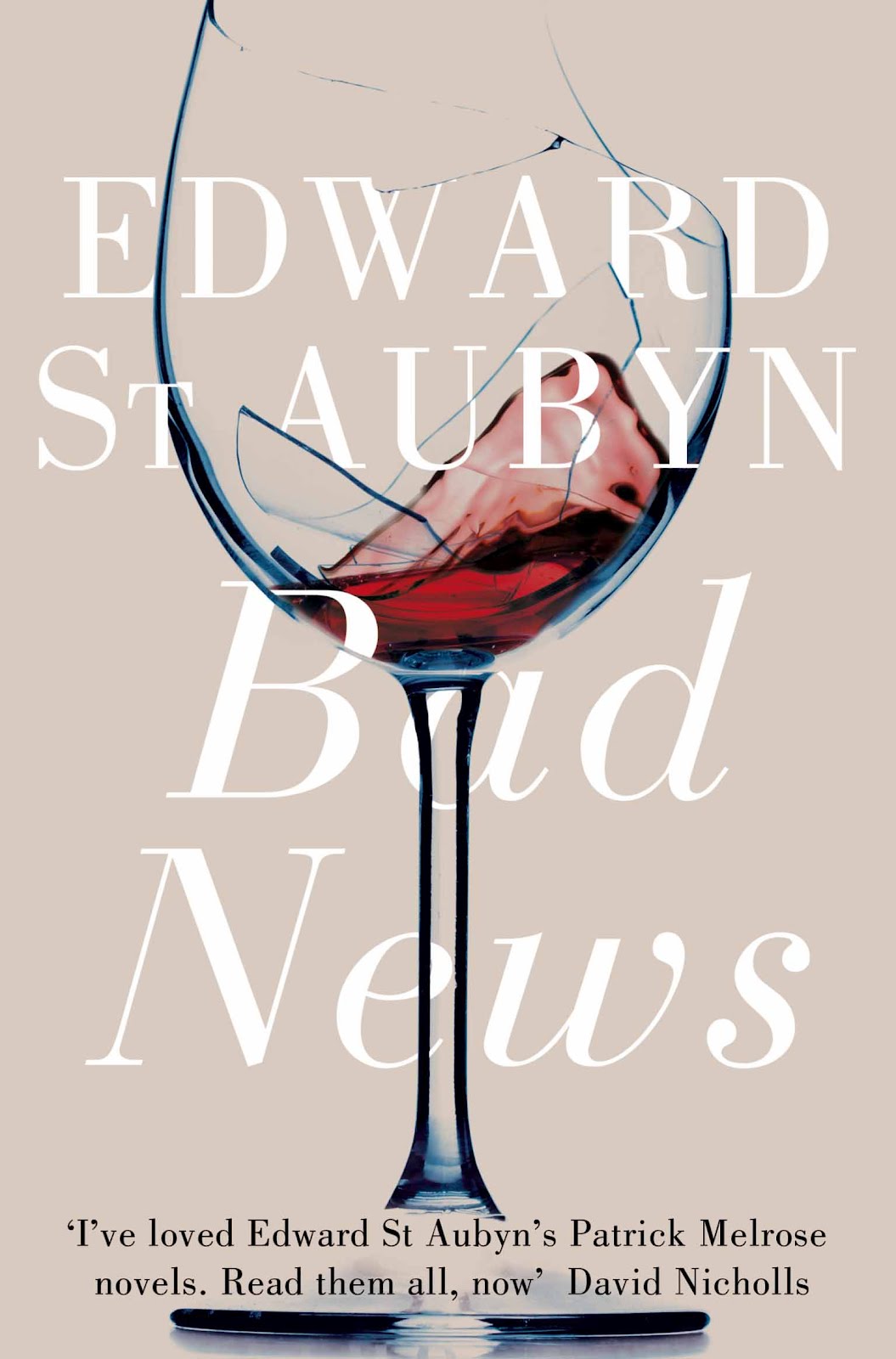
Edward St Aubyn - Bad News

Wow. I read this book in as close to one go as is possible with a young, energetic boy to look after. I feel like I've been on drugs myself; emerging from this visceral world was like sobering up, finally, after having been on some kind of crazy trip.

This book revisits Patrick Melrose, the five year old boy whose horrific abuse was central to Never Mind, and who is now in his early twenties. Hardly surprisingly, Patrick has not grown up to become a happy, well-adjusted adult. Instead he is a full-blown drug addict, injecting heroin and cocaine, balancing highs with lows so that he can, to some small extent, continue to interact with the world. The novel opens on Patrick sitting on a plane - the Concord, no less - on his way to pick up the remains of his dead father in New York. The pressure of that gruesome task and the impact of his abusive father's death on Patrick's psyche send him into a downward spiral in the form of a massive bender that lasts until he is back on the Concord, on his way back to England in possession of a box full of ashes.

Like the first book of the series, this one takes place over the space of a short time, about 48 hours in Patrick's intense life. Unlike Never Mind, though, this is told entirely from Patrick's viewpoint, save for a very short episode towards the end of the book which is told from the perspective of a girl who unwisely agrees to have dinner with Patrick in his significantly altered state. I'm not sure why St Aubyn felt it necessary here to depart from the third person limited narrator he otherwise uses consistently throughout the book. Whilst it is interesting to get a glimpse of how other people view Patrick during this period, I don't think the departure was necessary - it is blatantly clear, from our knowledge of what Patrick is doing, thinking, absorbing, that his altered state would render him less than impressive to people whose lives are not on the same track as his.

Patrick, in this book, is not a likeable character. But he is well aware of that fact, and makes up for it somewhat by despising himself more than any other person possibly could. He is self-absorbed and unable to cope with anyone else's emotional needs, including those of his girlfriend, Debbie, who he has left behind in England. We learn that he is having an affair with another girl, and thinks nothing of also trying to have a fling during his short visit to New York. This is a broken person, someone who is so consumed by their own breakdown that they have nothing left over to give the rest of the world. This state of being, combined with his aristocratic upbringing, causes Patrick to express himself exclusively in the cynical, nasty way that appears to be peculiar to a particular class of English people: "What was the point of a book if you couldn't carry it around with you as a theoretical defence against boredom?" There is no joy in Patrick's self-expression, which is fitting as there is a clear absence of joy in his life.

As well as the colourful cast of underworld characters he encounters on his constant search for more and better drugs, Patrick meets up again with some of the friends his parents had over for dinner in the first book of this series, Never Mind. One of the interesting things about the Patrick Melrose novels is the way the world of the British aristocracy is portrayed as being quite small - Patrick encounters and interacts with his parents' friends, in the absence of his parents, more than most of us these days would with members of another generation. The feeling this evokes is the inevitability of that world, the knowledge that there is no escaping it; by virtue of his birth, Patrick will always belong to this society, no matter how far he runs or how low he sinks.

Really, though, Bad News is mainly a terribly confronting novel about an addict's full descent into life-threatening drug abuse. There were times when I had to look away from the book, gathering myself before reading on, because the descriptions of dirty syringes and injecting into disappearing veins were so potent and so disturbing. There was a passage in which Patrick's altered mind took on multiple personalities, taunting him with endlessly fractured conversations, and reading this was like experiencing Patrick's disturbing high along with him. There were times when Patrick toyed with the idea of suicide, and his blase attitude towards it impressed upon me just how depressed he is, underneath all of the drugs: "As the telephone rang he wondered what kept him from suicide. Was it something as contemptible as sentimentality, or hope, or narcissism? No. It was really the desire to know what would happen next, despite the conviction that it was bound to be horrible: the narrative suspense of it all." At several points during the book Patrick almost dies from the rush he so relentlessly pursues, a fact that he accepts without surprise, shock or fear. I found it terribly sad that the momentary but extreme high upon injecting is the one second of happiness Patrick can find in his life, and even he knows that it is not a real happiness, and that it comes at an enormous cost.

Some reviewers have said how much they disliked Patrick in this book. But all I felt for him was immense pity. Here is a person struggling against a past that will not let him go; struggling with the certainty that nothing good could possibly lie ahead for him. I looked up at one stage in my reading and said to Bibliohubby how relieved I was that I am not a drug addict! It must be just awful, that merciless and exhausting need, from which there is no escaping. St Aubyn's writing of this world is just extraordinary; I don't know how he could have done this, distilling the essence of addiction and depression and grief into a 48 hour period in his protagonist's life, unless he had been there himself.

Overall assessment: 4.5 out of 5. I was blown away, again, by St Aubyn's electric writing, by the vividness of the characterisation, by the total immersion I felt in the prose and the story.

Pros / favourite passages: Even amidst the horror of Patrick's life St Aubyn manages to inject some of his characteristic caustic humour. When Patrick first makes his way to the funeral home where he is to pick up his father's ashes he is initially falsely directed to the wrong room, where a Jewish crowd is in mourning. St Aubyn writes: "Death was no doubt an overwhelming experience, but it must be even more powerful than he had imagined if it could transform his father into a small Jew with so many amusing new friends."

So much of this book is dedicated to the intricacies of drug addiction and the detailed mechanics of taking drugs, but St Aubyn still manages to illustrate the social milieu in which Patrick mixes, and the relationship between Patrick and his father since we last met him at five years old, using both to explore the themes of personal identity - how it is created, what creates it - and childhood, the failed raising of children amongst the British upper classes. When he meets a friend from England and stops to chat with her parents, they talk of Patrick's father, as one does about someone who has just died:

"But wouldn't we now say that he was just wery disturbed?" asked Eddy.
"So what if we did? When the effect somebody has is destructive enough the cause becomes a theoretical curiosity. There are some very nasty people in the world and it is a a pity if one of them is your father."
"I don't think that people noo so much about how to bring up kids in those days. A lot of parents in your fawther's generation just didn't know how to express their love."
"Cruelty is the opposite of love," said Patrick, "not just some inarticulate version of it."

Cons: As with Never Mind, there are very few cons to mention here, except for the darkness of the topic, and the fact that the vivid imagery was difficult to stomach at times.


Wednesday, March 27, 2013

Edward St Aubyn - Never Mind

This is the first book in a five-part series, and I felt after finishing it that I had really just read an extraordinary introduction to a larger story. Which is not to say that this book is not satisfying in and of itself - it is, deeply so - it just left me ready to immediately plunge into book two (which I did, by the way - with the next review to follow promptly).

I have had two people (one of them my erudite, extremely well-read mother) recently recommend St Aubyn's Patrick Melrose series to me, in particularly glowing terms. Maybe it was that hype which influenced my reading of the first few chapters, so that I was initially disappointed. Although the writing was spectacular from the beginning, for me the story unfolded slowly, like the earliest budding of a spring bloom. The exception, of course, was a scene in the first chapter describing a date which involved an extraordinary request by David Melrose, one of the protagonists, for a repulsive act of submission from the woman who would later become his wife. As it turns out, this was not even close to the most disturbing scene in the book.

St Aubyn chooses to tell Never Mind from the perspective of a third person omniscient narrator, and he employs this style to its hilt, by rushing in and out of the minds of different characters at dazzling speed. Very few writers can pull this off so convincincly - St Aubyn is one of them. I think the chopping and changing of the narrative threw me off initially, so that it took me a few chapeters to become fully immersed - but then, all of a sudden - whoosh! After three chapters or so of umm-ing and ah-ing, I was sucked in so thoroughly that the next time I looked up I was only a few pages away from finishing the book! Very odd indeed. I felt like I had been pulled into a vortex and then cast out the other side gasping for air, and gasping for more. I don't know if that has ever happened to me before, with a book. It was truly a bizarre reading experience, and I already know that more of the same awaits, in the next books of the series.

Never Mind covers a period of about 24 hours in the lives of exceptionally well-off British aristocrats who represent the very worst of English arrogance. David Melrose and his wife, Eleonor, live in Lacoste, France, and are hosting a dinner party for some of their 'closest friends' - none of whom escape David's scathing tongue or social critique. The book follows the various invitees in the lead-up to the dinner party, and during the party itself, but central to the story - although he is too young to attend the dinner - is the five year old son of David and Eleonor, Patrick Melrose. I have never read such a heartbreaking account of the abuse and pure neglect of a child. For St Aubyn to have conveyed this bleak, desperately sad childhood through the detail and description of just one day in the life of young Patrick, is quite remarkable.

Patrick is a loner because he has no choice in the matter. His father is a sociopath and his mother is a drug-addled alcoholic who is too weak to leave his father and too insecure to exert even the most basic maternal effort. He once had a nanny, but she has died by the time the book begins and his father has asserted that - at five - Patrick is too old to have another one. Patrick's valiant attempts to overcome these significant obstacles, by resorting to the very essence of boyhood, running around outside, taking daredevil risks as he climbs and scrapes his way through the forest landscape, making up his own games, stealing food from the kitchen, are thwarted in the period St Aubyn writes of by his father's indescribable offences against his person which escalate on this particular day to an abuse from which Patrick will never recover.

All of the people depicted in this book (other than Patrick Melrose, and perhaps the American, Anne, who seems to exist in order to provide a cultural counterpoint to the British upper crust) are thoroughly despicable, and they are described doing horrific things: sado-masochism without explicit consent, violent rape, child abuse, paedophilia. Yet once the pull of St Aubyn's narrative current sets in, it is impossible to stop reading about them. This was one of those books that kept me awake after lights-out, hiding like a child again with my book under the bedcovers so as not to disturb Bibliohubby, fighting against fatigue in order to read just one more page, one more page after that, and so on. Extraordinary.

Overall assessment: 4.5 out of 5

Pros / favourite passages: The writing is achingly beautiful, and stands in stark contrast to the dark subjects St Aubyn explores. It is also funny, exhibiting a dry wit peculiar to the English: in describing a school friend's current occupation, David Melrose says he was "a civil servant who was widely thought to be a spy because his job sounded too dull to exist." David himself is described with great subtlety, including observations like this: "To break even the smallest rules by which others convinced themselves that they were behaving correctly gave him great pleasure." And this: "David grinned. He was in the mood for fun. After all, what redeemed life from complete horror was the almost unlimited number of things to be nasty about."

The particular class of people who populate the novel are rendered with great care, not just through physical descriptions but also through the philosophies they espouse: "'What one aims for', said David, 'is ennui.' 'Of course,' said Anne, 'it's more than just French for our old friend boredom. It's boredom plus money, or boredom plus arrogance. It's I-find-everything-boring, therefore I'm fascinating.'" And from David's wife: "Eleanor still found it inexplicable that the best English manners contained such a high proportion of outright rudeness and gladiatorial combat. She knew that David abused this licence, but she also knew how 'boring' it was to interfere with the exercise of unkindness."

David justifies to himself his cruel and inhumane treatment of Patrick by the viewpoint he expresses in a conversation over dinner: "The proposition I want to make, is that education should be something of which a child can later say: if I survived that, I can survive anything." His friend Nicholas later chimes in: "I may be a frightful reactionary, but I think that all you have to do for children is hire a reasonable nanny and put them down for Eaton."

These views are beautifully borne out by the fact that we as readers know that while this conversation is occurring, poor little five year old Patrick is sitting miserably on the stairs, waiting for his mother to come and comfort him after having lived the worst day in his young life. But she never does come.

After reading this book I held Iggy closer and cuddled him tighter, and was reluctant to let go of him even so that he could sleep in his own bed. What a devastation it is when love is withheld from a child, and what an inevitability it surely is when that child subsequently grows to become an adult who is capable of living only on the very edges of society.

Cons: I am hard-pressed to find them, though I have given this just shy of 5 stars because its subject matter is so very dark. I was left after reading this feeling shell-shocked, and now that I have read the second one too, that feeling is only enhanced.