Showing posts with label book review. Show all posts
Tuesday, April 9, 2013
Jennifer Egan - Look at Me
So, I turned back to Egan as promised in order to determine whether she really does hold a place as one of my favourite female writers, whether A Visit from the Goon Squad was her literary highlight, whether her voice in more traditional story-telling mode is as magnetic.
Look at Me is a hugely ambitious book. It is beautifully written and plot-driven, but it also acts as an in-depth exploration of larger themes and philosophical questions, particularly over the nature of identity, and the modern prioritisation of image at the expense of authenticity.
Egan took six years to write this book and it shows; it is populated with a large cast of characters, each taking turns in the narrative spotlight, and each illustrating Egan's theme from a new perspective.
Really, though, this is a tale of two Charlottes.
Charlotte Swenson is a 35 year-old model whose face has been wrecked in a car accident and whose reconstructive surgery leaves her with a face so different from her old one that nobody recognises her. Charlotte is an enigma. She is consumed by the desire to succeed in the public eye, to enter what she calls "The Mirrored Room", that elite space reserved for those in our modern society who have obtained a glorified celebrity status - the rich and famous, the beautiful. Her ticket in, before the accident, was her beauty, her face. Although she never made it to the realm of true, stratospheric stardom, she was close enough to be considered 'one of the beauties' on a circuit of wealthy hotspots around the world and in the exclusive nightclubs of New York City. But there is a deeper side to Charlotte, revealed in her ability to glimpse people's 'shadow selves' - their true selves, their real identity, which most people take great pains to hide from the world in favour of what they want the world to see. After her accident Charlotte also starts seeing the 'shadow self' of Manhattan - old signs, hidden behind modern buildings, still plastered on old brick walls, representing a bygone era. Interestingly, these glimpses of the past soothe Charlotte, who otherwise seems so preoccupied by flashy facades.
After realising that her new face means she will never succeed again at modelling, Charlotte finds a new way to sell her soul - to a dot com start-up. Extra/Ordinary commoditises lives on the internet, in an attempt to capture reality and expose it for the masses to see. Inevitably, the 'life' represented online is a departure from reality rather than its essence - it is manufactured, with the manufacturing done by other people: ghost writers, film directors, 'experts'. Even as she achieves the kind of success that she has always dreamed of, Charlotte becomes deeply uncomfortable with the artifice of her manufactured life. She has sold her soul to gain entry to the mirrored room, which she ultimately recognises for what it is: an arbitrary space filled with empty, superficial people, "chimeras... the hard, beautiful seashells left behind long after the living creatures within have struggled free and swum away". She finally realises this is not what she wants, after all, and it thus becomes clear that the loss of Charlotte's face in fact marked the start of her painful journey towards authenticity.
Charlotte Swenson's life is played out against the life of another Charlotte, a high school girl who lives in model-Charlotte's hometown. Young Charlotte suffers at school because of her plain looks and her initial unwillingness to play the games that characterise some of the more shallow social interactions between teenagers. She is a strong young woman with a fierce sense of her own independence and self-worth, traits which have no doubt been developed in response to her younger brother's struggle with leukaemia and her parents' understandable preoccupation with their son's well-being. As she distances herself from her cliquey school and her popular friends, young Charlotte finds herself increasingly drawn to two men. One is her uncle, Moose, who battles against a madness caused by an epiphany he had years earlier, in which he recognised the past as ever-present behind the superficial trappings of modern day America - much as model-Charlotte sees the shadow-self of New York City behind its new facade. Moose's x-ray vision, however, has led him to believe that the modern structures of current-day society, which hide beneath them the true history of America, spell the doom of humanity. He is frustrated by his inability to relay this vital doomsday message to anybody else and hopes that young Charlotte might be his protege, teaching her obsessively about the history of their small town in the hope that her own epiphany lies around the corner.
The other man in young Charlotte's life is a mysterious maths teacher called Michael West, who is not from the West at all, but who arrived in America from somewhere far East with the intent of destroying America, or some part of it. Michael West believes, upon arriving in the States, that the intoxicating images that are exported from the USA to the world, of beautiful women in night clubs and tall buildings made of steel and glass, and the global dissemination of these artifices through ubiquitous fast food and Hollywood movies, are signs of an American conspiracy to take over the world through eroding the authenticity and cultural reality of other places. It is not until he arrives in America that he is gradually lulled into the peaceful acceptance that there is no conspiracy. Americans themselves, he realises, believe in the images they project, and they are too drugged by the artifice to recognise the danger these represent to the rest of the world.
A South African friend of mine once said that the secret to world peace was a backyard and a two car garage - that once people were relatively happy with their lot in life they were far less likely to go and fight wars. Michael West's desire to destroy America dissolves as he gradually absorbs the American life, even going so far as to adopt a layer of fat over his taut physique from ingesting McDonald's, that iconic symbol of American imperialism. He comes to realise that he can be a part of the image he had previously so despised, and that this is a much easier way to live than maintaining his struggle against the artifice and a rage so intense it has caused him to walk out on marriage after marriage, life after life.
Young Charlotte, fighting against the perceived importance of beauty that is the reality at American high schools, feels a kindred tie to both of these men, but does not consciously recognise why she is drawn to them. She is looking for something but cannot explain even to herself what that is.When her own beauty gradually emerges - through the artifice, of course, of well-applied make-up and (like Clark Kent into Superman) the removal of her glasses - she finds the complications of trying to live like her Uncle, or emulating the secrecy and just-suppressed rage of Michael West, too difficult. What she most wants, after all, is what all high school students ultimately want: to fit in, even if that is at the expense of their true selves.
In direct contrast to model-Charlotte, she moves from determinedly gripping onto reality and actively pursuing authenticity, to embracing shallow artifice. Like Charlotte, though, the vehicle for her transformation is her face, in this case the adoption of a false one which allows her to sink easily into the contrived homogeneity of a high school crowd.
The various storylines of this book eventually collide and we are left with a scathing view of modern society, and a dire prediction for the near future, a future which has, to a large extent, already come to pass since the publication of the book in 2001. With the advent of Facebook, the rise and growth of reality TV, the obsession with sharing our lives with the world through Twitter, Instagram and so on - much of what Egan seems to be warning against in Look at Me has already happened. I wonder whether she now feels that it is too late for the world.
Overall assessment: 4 out of 5. I really enjoyed this book, but somehow it hasn't touched me as deeply as I think it should, given the subject matter. One reason for this may be the ending, which for me didn't quite come together with the emotional impact it could have, or should have. The project may have been overly ambitious. Many clever parallels are drawn between the two Charlottes that don't quite add up - model-Charlotte's obsession with 'Z' and young-Charlotte's obsession with Michael West, for example, mark a mid-point in both of their journeys where they were in the same place, emotionally, though moving in opposite directions on their journeys to/from authenticity. But this doesn't hit home for readers in any significant sense because the story is too big.
Pros / favourite part(s): Egan's writing is beautiful; I highlighted large sections of text simply to remind myself later how extraordinarily apt were her metaphors, how unusual her capacity to describe ordinary things in a way that made them somehow extraordinary. Her writing reminds me in some ways of Jonathan Franzen's, or perhaps it is the other way around - they certainly share some similarities. Her story-telling is for the most part gripping, and reminds me in places of Anne Patchett's. It is safe to say that Egan does now hold a position in my library as one of my favourite female writers.
There were scenes in this book that gave me chills. For example, soon after returning to New York post-accident, model-Charlotte thinks she still has a chance to succeed in the modelling industry when she is offered a photo shoot with Italian Vogue. Paparazzo turned fashion photographer Spiro is at the helm, having become an instant sensation after a shoot replicating gang violence, which has spawned a trend in fashion photography for photographing 'real' people 'from the news', rather than mere models. All seems to be going well until the make-up artist takes out a razor blade and it becomes clear that, in this shoot, authenticity is to be won through actually cutting the models and recording their fresh blood. Charlotte, with her fragile, newly recovered face, a face put back together with 80 titanium screws, refuses to go through with it - only to be told that she 'doesn't get it', she's not real enough. She is replaced on set by a real refugee of North Korea, a girl so empty of power that she cries silently as the razor blade slides across her cheek.
As Egan writes towards the end of the book, reality, or truth, is something that burrows further inside a dark, coiled privacy when the light of publicity is shone on it - "it dies the instant it is touched by light" because "life can't be sustained under the pressure of so many eyes". Moments like these were deeply touching.
Cons: The ending is disappointing. I feel as though Egan had wanted to write a climax in which all of the strands of her story came together powerfully, in one momentous scene (like the ending of John Irving's A Prayer from Owen Meany, one of my favourite books), but it didn't quite work. For one thing, the life of model-Charlotte somewhat outshone that of young Charlotte, and so it was difficult to see them or treat them as two sides of a coin, which I think they were meant to be. Young Charlotte's transformation did not seem nearly as meaningful as the transformation of model-Charlotte, which was perhaps a result of the fact that Moose and Michael West to some extent took over as minor protagonists of their own in her story.
I still finished the book feeling it had been a very good read, and a fascinating one at that - but I was also left thinking that at the time of publication, Egan's potential as a story-teller was yet to reach its zenith. Perhaps the Pulitzer-prize winning A Visit from the Goon Squad is that zenith, or perhaps it is still to come. I hope for the latter.
Note: Egan suffered upon release of this book because it came a few short months after 9/11, though she had finished the writing of it well before that tragedy. The terrorist character of 'Z' in this book is therefore sometimes seen as outdated, and she has written a note at the end of the book to explain the reason for this. For my part, I wasn't irked by my awareness of intervening events in America, although it does date the book. American readers might feel differently.
Thursday, April 4, 2013
Edward St Aubyn - Some Hope
I hope this isn't too boring for all of you. Once I find an author I like, I can be like a dog with a bone - I like to read through a number of their books immediately, until I am familiar enough with their work to know if I will want to buy the next-released book as a matter of course, or whether the book I read first was a stand-out anomaly. So I emerged from Edward St Aubyn's explosive Bad News and turned immediately and greedily to his next Patrick Melrose book, Some Hope. I do promise that I will pick up a different writer next, to prevent this blog from becoming exclusively St Aubyn-themed! This novel opens on Patrick Melrose in his 30th year. I now feel that it would be accurate to describe at least the first three parts of this five part series as the story of Patrick and his relationship with his father. Although his father is dead by the time the second novel begins, the personhood of Patrick throughout his life is obviously shaped by his feelings about his father. In this third instalment, we see Patrick clean, after successfully battling his addictions through numerous stints in rehab, still miserable, trying to find a way somehow to make peace with his dead father so that he can move on and, perhaps, find a way after all to live a useful life.
The backdrop to all of this internal strife is the gathering of various guests for a grand party at a country estate, in honour of Princess Margaret. St Aubyn here returns to the omniscient third narrator he used in Never Mind, and again uses it with wild abandon - the first half of the book leaps around to so many different characters that I found it quite difficult to remember who was who, and started wishing I had kept notes to remind myself. I actually think this would have helped my reading. As it was, I read this far more slowly than I did the first two books, with less absorption. But in the end it didn't matter - eventually the plot coalesced and the description of the party itself is a riotous read, rife with the colourful depictions of grotesque English upper-class arrogance that were so successful in the first book of this series. Really the success of these books is the ability St Aubyn has of defining and commenting so astutely on an entire class and country of people whilst keeping readers meanwhile occupied with the intriguing but smaller story of just one member of this class. As it stands, the Patrick Melrose series is a scathing indictment of the British upper class and what it represents, and how archaic, ineffectual and irrelevant it now is. In this book, St Aubyn flirts with controversy by including royalty in his critique. Princess Margaret is painted as a fatuous, mean-spirited megalomaniac - not very different from many of the other attendees at the party - and I felt as I read the account of her that St Aubyn had probably got it spot-on.
At times while I was reading this I thought nothing much was happening - but then I finished it and realised that actually tons had happened. Patrick determines that perhaps one way of dealing with his past is to be truthful about it, to talk about it, and he takes the giant step of confessing to his great friend Johnny Hall what happened to him as a child. Whilst this doesn't immediately heal all, it does help Patrick realise that forgiveness, something that has been eluding him for years, might not be necessary after all; perhaps a simple acknowledgement and acceptance of the person his father was, and of what had shaped him, was enough. Various characters from the previous two novels in the series return, some quite surprising. Bridget, who was a pretty but common girl brought along to France as the sexual plaything of the contemptible Nicholas Pratt (and so he is) in the first book, reappears after a society marriage as the hostess of the chic party central to Some Hope. Her husband, Sonny Gravesend, has been having an affair that everyone knows about and which will come to a head at the party itself. One of Patrick's acquaintances from the drug years returns in a very unexpected cameo. And the French ambassador to England has an embarrassing and very public moment when he accidentally spills sauce from the dinner he is eating over Princess Margaret's dress and is required by Her Highness herself to kneel before her and clean it up, in front of everybody.
Critics have compared St Aubyn's brilliantly sardonic comic writing to Evelyn Waugh, Graham Greene - or an English Philip Roth. Certainly he has a sensational power to paint vivid pictures in the mind, and to draw memorable characters. It is increasingly clear as the series progresses that St Aubyn is also deeply interested in the notion of identity, what it means and where it comes from. Patrick is the perfect vehicle within which to explore this theme, and I look forward to seeing where he takes us next. At the end of this book we are left - as the title would suggest - feeling that there might be some hope for Patrick after all.
Overall assessment: 3.5 out of 5 - not quite the same level, for me, as the earlier two novels in this series, but fascinating nonetheless, and certainly this book does not detract from the genius of the enterprise as an entirety.
Pros / favourite passages: Patrick's obsession with and difficulty escaping from the legacy of his father is brilliantly portrayed. "The memory of his father still hypnotized him and drew him like a sleepwalker towards a precipice of unwilling emulation." "He wanted to break into a wider world, to learn something, to make a difference. Above all, he wanted to stop being a child without using the cheap disguise of becoming a parent." "How could he find any firm ground when his identity seemed to begin with disintegration and go on to disintegrate further? But perhaps this whole model of identity was misconceived. Perhaps identity was not a building for which one had to find foundations, but rather a series of impersonations held together by a central intelligence, an intelligence that knew the history of the impersonations and eliminated the distinction between action and acting." "What could he do but accept the disturbing extent to which memory was fictional and hope that the fiction lay at the service of a truth less richly represented by the original facts?"
On telling the truth about what happened to him as a child: "But which words could he use? All his life he'd used words to distract attention from this deep inarticulacy, this unspeakable emotion which he would now have to use words to describe. How could they avoid being noisy and tactless, like a gaggle of children laughing under the bedroom window of a dying man?"
Cons: The narration here moved awfully quickly and for me prevented a full surrender to the story until quite late in the book.
Also, and this is not really a con, but an observation of something I find troubling: these people are awful towards their children! After the wry observations by David Melrose and Nicholas Pratt in Never Mind, here Bridget represents stiff-upper-lip British parenting: she leaves her young child with a brutal nanny and refuses to spend time with her. She is also awful towards her own mother, which, as a mother myself, I found somewhat hard to believe - if there is anything motherhood teaches you, it is how much you owe your own parents! Interestingly St Aubyn uses the notion of attentive parenting to define Bridget's turn-around towards the end of the book: when she finally, bravely decides to walk out on her appalling husband (at least temporarily), she takes her daughter with her, and her mother, leaving the nanny behind. Perhaps there is hope here, too, although what is fascinating is that this move simultaneously represents a return from upper-class society back to the common origins from which Bridget stems. As though St Aubyn is telling us that belonging to the upper crust of British society is mutually exclusive with real emotion, with genuinely close family relations, with loving one's children.
Sunday, March 31, 2013
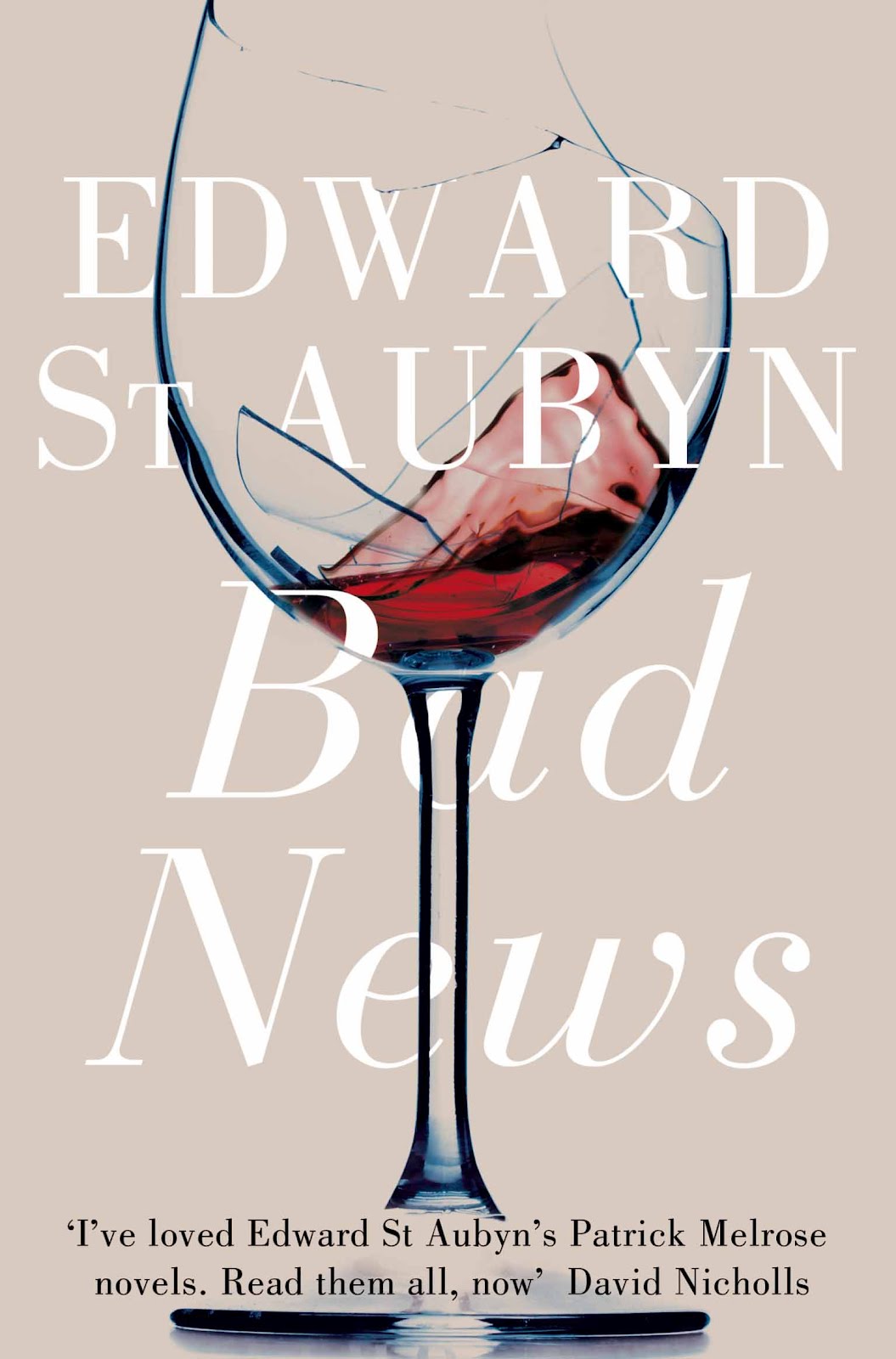
Edward St Aubyn - Bad News
Wow. I read this book in as close to one go as is possible with a young, energetic boy to look after. I feel like I've been on drugs myself; emerging from this visceral world was like sobering up, finally, after having been on some kind of crazy trip.
This book revisits Patrick Melrose, the five year old boy whose horrific abuse was central to Never Mind, and who is now in his early twenties. Hardly surprisingly, Patrick has not grown up to become a happy, well-adjusted adult. Instead he is a full-blown drug addict, injecting heroin and cocaine, balancing highs with lows so that he can, to some small extent, continue to interact with the world. The novel opens on Patrick sitting on a plane - the Concord, no less - on his way to pick up the remains of his dead father in New York. The pressure of that gruesome task and the impact of his abusive father's death on Patrick's psyche send him into a downward spiral in the form of a massive bender that lasts until he is back on the Concord, on his way back to England in possession of a box full of ashes.
Like the first book of the series, this one takes place over the space of a short time, about 48 hours in Patrick's intense life. Unlike Never Mind, though, this is told entirely from Patrick's viewpoint, save for a very short episode towards the end of the book which is told from the perspective of a girl who unwisely agrees to have dinner with Patrick in his significantly altered state. I'm not sure why St Aubyn felt it necessary here to depart from the third person limited narrator he otherwise uses consistently throughout the book. Whilst it is interesting to get a glimpse of how other people view Patrick during this period, I don't think the departure was necessary - it is blatantly clear, from our knowledge of what Patrick is doing, thinking, absorbing, that his altered state would render him less than impressive to people whose lives are not on the same track as his.
Patrick, in this book, is not a likeable character. But he is well aware of that fact, and makes up for it somewhat by despising himself more than any other person possibly could. He is self-absorbed and unable to cope with anyone else's emotional needs, including those of his girlfriend, Debbie, who he has left behind in England. We learn that he is having an affair with another girl, and thinks nothing of also trying to have a fling during his short visit to New York. This is a broken person, someone who is so consumed by their own breakdown that they have nothing left over to give the rest of the world. This state of being, combined with his aristocratic upbringing, causes Patrick to express himself exclusively in the cynical, nasty way that appears to be peculiar to a particular class of English people: "What was the point of a book if you couldn't carry it around with you as a theoretical defence against boredom?" There is no joy in Patrick's self-expression, which is fitting as there is a clear absence of joy in his life.
As well as the colourful cast of underworld characters he encounters on his constant search for more and better drugs, Patrick meets up again with some of the friends his parents had over for dinner in the first book of this series, Never Mind. One of the interesting things about the Patrick Melrose novels is the way the world of the British aristocracy is portrayed as being quite small - Patrick encounters and interacts with his parents' friends, in the absence of his parents, more than most of us these days would with members of another generation. The feeling this evokes is the inevitability of that world, the knowledge that there is no escaping it; by virtue of his birth, Patrick will always belong to this society, no matter how far he runs or how low he sinks.
Really, though, Bad News is mainly a terribly confronting novel about an addict's full descent into life-threatening drug abuse. There were times when I had to look away from the book, gathering myself before reading on, because the descriptions of dirty syringes and injecting into disappearing veins were so potent and so disturbing. There was a passage in which Patrick's altered mind took on multiple personalities, taunting him with endlessly fractured conversations, and reading this was like experiencing Patrick's disturbing high along with him. There were times when Patrick toyed with the idea of suicide, and his blase attitude towards it impressed upon me just how depressed he is, underneath all of the drugs: "As the telephone rang he wondered what kept him from suicide. Was it something as contemptible as sentimentality, or hope, or narcissism? No. It was really the desire to know what would happen next, despite the conviction that it was bound to be horrible: the narrative suspense of it all." At several points during the book Patrick almost dies from the rush he so relentlessly pursues, a fact that he accepts without surprise, shock or fear. I found it terribly sad that the momentary but extreme high upon injecting is the one second of happiness Patrick can find in his life, and even he knows that it is not a real happiness, and that it comes at an enormous cost.
Some reviewers have said how much they disliked Patrick in this book. But all I felt for him was immense pity. Here is a person struggling against a past that will not let him go; struggling with the certainty that nothing good could possibly lie ahead for him. I looked up at one stage in my reading and said to Bibliohubby how relieved I was that I am not a drug addict! It must be just awful, that merciless and exhausting need, from which there is no escaping. St Aubyn's writing of this world is just extraordinary; I don't know how he could have done this, distilling the essence of addiction and depression and grief into a 48 hour period in his protagonist's life, unless he had been there himself.
Overall assessment: 4.5 out of 5. I was blown away, again, by St Aubyn's electric writing, by the vividness of the characterisation, by the total immersion I felt in the prose and the story.
Pros / favourite passages: Even amidst the horror of Patrick's life St Aubyn manages to inject some of his characteristic caustic humour. When Patrick first makes his way to the funeral home where he is to pick up his father's ashes he is initially falsely directed to the wrong room, where a Jewish crowd is in mourning. St Aubyn writes: "Death was no doubt an overwhelming experience, but it must be even more powerful than he had imagined if it could transform his father into a small Jew with so many amusing new friends."
So much of this book is dedicated to the intricacies of drug addiction and the detailed mechanics of taking drugs, but St Aubyn still manages to illustrate the social milieu in which Patrick mixes, and the relationship between Patrick and his father since we last met him at five years old, using both to explore the themes of personal identity - how it is created, what creates it - and childhood, the failed raising of children amongst the British upper classes. When he meets a friend from England and stops to chat with her parents, they talk of Patrick's father, as one does about someone who has just died:
"But wouldn't we now say that he was just wery disturbed?" asked Eddy.
"So what if we did? When the effect somebody has is destructive enough the cause becomes a theoretical curiosity. There are some very nasty people in the world and it is a a pity if one of them is your father."
"I don't think that people noo so much about how to bring up kids in those days. A lot of parents in your fawther's generation just didn't know how to express their love."
"Cruelty is the opposite of love," said Patrick, "not just some inarticulate version of it."
Cons: As with Never Mind, there are very few cons to mention here, except for the darkness of the topic, and the fact that the vivid imagery was difficult to stomach at times.
This book revisits Patrick Melrose, the five year old boy whose horrific abuse was central to Never Mind, and who is now in his early twenties. Hardly surprisingly, Patrick has not grown up to become a happy, well-adjusted adult. Instead he is a full-blown drug addict, injecting heroin and cocaine, balancing highs with lows so that he can, to some small extent, continue to interact with the world. The novel opens on Patrick sitting on a plane - the Concord, no less - on his way to pick up the remains of his dead father in New York. The pressure of that gruesome task and the impact of his abusive father's death on Patrick's psyche send him into a downward spiral in the form of a massive bender that lasts until he is back on the Concord, on his way back to England in possession of a box full of ashes.
Like the first book of the series, this one takes place over the space of a short time, about 48 hours in Patrick's intense life. Unlike Never Mind, though, this is told entirely from Patrick's viewpoint, save for a very short episode towards the end of the book which is told from the perspective of a girl who unwisely agrees to have dinner with Patrick in his significantly altered state. I'm not sure why St Aubyn felt it necessary here to depart from the third person limited narrator he otherwise uses consistently throughout the book. Whilst it is interesting to get a glimpse of how other people view Patrick during this period, I don't think the departure was necessary - it is blatantly clear, from our knowledge of what Patrick is doing, thinking, absorbing, that his altered state would render him less than impressive to people whose lives are not on the same track as his.
Patrick, in this book, is not a likeable character. But he is well aware of that fact, and makes up for it somewhat by despising himself more than any other person possibly could. He is self-absorbed and unable to cope with anyone else's emotional needs, including those of his girlfriend, Debbie, who he has left behind in England. We learn that he is having an affair with another girl, and thinks nothing of also trying to have a fling during his short visit to New York. This is a broken person, someone who is so consumed by their own breakdown that they have nothing left over to give the rest of the world. This state of being, combined with his aristocratic upbringing, causes Patrick to express himself exclusively in the cynical, nasty way that appears to be peculiar to a particular class of English people: "What was the point of a book if you couldn't carry it around with you as a theoretical defence against boredom?" There is no joy in Patrick's self-expression, which is fitting as there is a clear absence of joy in his life.
As well as the colourful cast of underworld characters he encounters on his constant search for more and better drugs, Patrick meets up again with some of the friends his parents had over for dinner in the first book of this series, Never Mind. One of the interesting things about the Patrick Melrose novels is the way the world of the British aristocracy is portrayed as being quite small - Patrick encounters and interacts with his parents' friends, in the absence of his parents, more than most of us these days would with members of another generation. The feeling this evokes is the inevitability of that world, the knowledge that there is no escaping it; by virtue of his birth, Patrick will always belong to this society, no matter how far he runs or how low he sinks.
Really, though, Bad News is mainly a terribly confronting novel about an addict's full descent into life-threatening drug abuse. There were times when I had to look away from the book, gathering myself before reading on, because the descriptions of dirty syringes and injecting into disappearing veins were so potent and so disturbing. There was a passage in which Patrick's altered mind took on multiple personalities, taunting him with endlessly fractured conversations, and reading this was like experiencing Patrick's disturbing high along with him. There were times when Patrick toyed with the idea of suicide, and his blase attitude towards it impressed upon me just how depressed he is, underneath all of the drugs: "As the telephone rang he wondered what kept him from suicide. Was it something as contemptible as sentimentality, or hope, or narcissism? No. It was really the desire to know what would happen next, despite the conviction that it was bound to be horrible: the narrative suspense of it all." At several points during the book Patrick almost dies from the rush he so relentlessly pursues, a fact that he accepts without surprise, shock or fear. I found it terribly sad that the momentary but extreme high upon injecting is the one second of happiness Patrick can find in his life, and even he knows that it is not a real happiness, and that it comes at an enormous cost.
Some reviewers have said how much they disliked Patrick in this book. But all I felt for him was immense pity. Here is a person struggling against a past that will not let him go; struggling with the certainty that nothing good could possibly lie ahead for him. I looked up at one stage in my reading and said to Bibliohubby how relieved I was that I am not a drug addict! It must be just awful, that merciless and exhausting need, from which there is no escaping. St Aubyn's writing of this world is just extraordinary; I don't know how he could have done this, distilling the essence of addiction and depression and grief into a 48 hour period in his protagonist's life, unless he had been there himself.
Overall assessment: 4.5 out of 5. I was blown away, again, by St Aubyn's electric writing, by the vividness of the characterisation, by the total immersion I felt in the prose and the story.
Pros / favourite passages: Even amidst the horror of Patrick's life St Aubyn manages to inject some of his characteristic caustic humour. When Patrick first makes his way to the funeral home where he is to pick up his father's ashes he is initially falsely directed to the wrong room, where a Jewish crowd is in mourning. St Aubyn writes: "Death was no doubt an overwhelming experience, but it must be even more powerful than he had imagined if it could transform his father into a small Jew with so many amusing new friends."
So much of this book is dedicated to the intricacies of drug addiction and the detailed mechanics of taking drugs, but St Aubyn still manages to illustrate the social milieu in which Patrick mixes, and the relationship between Patrick and his father since we last met him at five years old, using both to explore the themes of personal identity - how it is created, what creates it - and childhood, the failed raising of children amongst the British upper classes. When he meets a friend from England and stops to chat with her parents, they talk of Patrick's father, as one does about someone who has just died:
"But wouldn't we now say that he was just wery disturbed?" asked Eddy.
"So what if we did? When the effect somebody has is destructive enough the cause becomes a theoretical curiosity. There are some very nasty people in the world and it is a a pity if one of them is your father."
"I don't think that people noo so much about how to bring up kids in those days. A lot of parents in your fawther's generation just didn't know how to express their love."
"Cruelty is the opposite of love," said Patrick, "not just some inarticulate version of it."
Cons: As with Never Mind, there are very few cons to mention here, except for the darkness of the topic, and the fact that the vivid imagery was difficult to stomach at times.
Labels:
2013 Reviews,
addiction,
Bad News,
book review,
Books,
breakdown,
cycle of abuse,
drug literature,
drugs,
Edward St Aubyn,
English books,
English society,
Patrick Melrose series,
reading,
societal critique
Thursday, January 24, 2013
Paul Harding - Tinkers
I have so much to say about this book, yet I must admit that my appreciation of it started off oh-so-slowly. Tinkers won the 2010 Pulitzer Prize for Fiction - not my favourite prize. I know it sounds incredibly snooty to say this (indeed, to 'have' a favourite literary prize at all), but my favourite literary prize is the Man Booker - only because I almost always love the books that win it. I equate the Pulitzer, for some reason, with dry, lofty writing - although I have just looked up a list of past winners and now see that this is completely unfounded: I love Jhumpa Lahiri and Annie Proulx and Carol Shields and Barbara Kingsolver and Geoffrey Eugenides and Junot Diaz and have heard wonderful things about Jennifer Egan, so I have no idea what I was thinking. So maybe, actually, it's because of my recent reading of Steve Hely's cynical take on literary writing that when I started reading this book it was hard for me to absorb the beauty of the language without feeling like it was all a bit too much, a bit try-hard. Boy did that change.
Tinkers is our bookclub pick for this month, and although I will be away traveling when the Bibliofillies meet, I wanted to participate by at least reading the book, so I soldiered on.
Having reached the end, the words I now want to use to describe Harding's writing are the same words everybody else has already used - lyrical, eligiac, nostalgic. Beautiful. It did not surprise me to learn that Harding is also a musician - you can feel it in the rhythm of his language. It just took me a while to sink into the music of his writing and truly appreciate what I was hearing.
George Washington Crosby, a repairer of clocks, lies dying in the house that he built, surrounded by wife, sisters, children and grandchildren. The unusual nature of the narrative that is to follow is signified by the first line:
"George Washington Crosby began to hallucinate eight days before he died."
The short novel that ensues is a meandering exploration of last thoughts and memories, stories layered within stories, lives overlapping lives and time folding in on itself so that one is left, finally, with indelible impressions of the transient beauty of both life and death, and of the importance of family.
Much of the core of the novel is dedicated to the story of George's father, Howard, told interchangeably in third person and first person. Howard is a peddler of wares, a salesman of oddities who wheels his wagon from town to town, through wood and vale. He is also an epileptic, in an age when this is not well understood or accepted. Certain unconnected moments in Howard's itinerant life are described in detail, and it is these that for me formed the heart of the story: his annual interactions with a silent hermit who, one year, needs his tooth pulled, and who gifts Howard before his death with a signed first edition of The Scarlet Letter, thereby confirming his onetime friendship with Nathaniel Hawthorne; the time he reluctantly set out to rescue George and return him home, when George had run away in shock as a young boy after witnessing one of his father's fits; the moment his (Howard's) father, suffering from an ailment of the mind that is described as a ghostly fading away of himself (Altzheimer's?), is removed forever from the family by men clad in black, and which Howard, as a boy, responds to by running into the woods attempting to find the teeth of his father hidden in an ear of corn, the hair of his father in the foliage, eventually sinking into a silt-filled pond and sitting like this, with only his head above water, for a whole night, during which he believes he sees the native American Old Sabbatis sitting similarly submerged, a still head floating on the water across from him, still save for the moment when a whole trout jumps out of the water and into the open mouth of Old Sabbatis. The tales are interwoven like squares on a patchwork quilt, and some take on the nature of fable, so one is not sure, for example, about the veracity of the Nathaniel Hawthorne story, until George, 24 hours from his death, remembers he must tell his family about the signed first edition hidden in a safety deposit box.
I warmed to Howard and, through him, to George, and the reason this book resonated for me, and will continue to resonate long after the reading of it, is that this portrayal of death is as uplifting, somehow, as it is real. I cried when I finished the last page, but not from sadness, and it is hard to explain exactly why or what made me cry. There is a warmth and a relief, I suppose, in the knowledge that life continues in this winding fashion, that through us other lives continue, that through others, our lives will continue, and that the significance of a son to his father and a father to his son is not diminished by age or distance or by death.
At the end of his life George becomes aware of a person in the room with him, when he wakes (or believes he wakes) in the middle of the night. The person is familiar but he cannot identify whether the person is male or female, friend or family. The person, I believe is us, or God, or maybe the point is that God - what we think of as God - is in us, because:
"...the person radiated a sense of possessing hundreds of years, but as a simultaneity: The person contained hundreds of years, but they overlapped, as if the person experienced any number of times at once."
The person says:
"I was just thinking that I am not very many years old, but that I am a century wide. I think that I have my literal age but am surrounded in a radius of years. I think that these years of days, this near century of years, is a gift from you. Thank you."
It is, to me, as though we are physically represented in the story, here - that we are that person, at George's bedside, that by reading this book and understanding his thoughts and the reflections of time upon time, of George and Howard and Howard's father - three generations of men in the same family - we understand that we are both our literal age but that we are also surrounded by a near century of years: not just the century of the lives George brings to us, but the century of those actually around us, and we thank George for the gift of recognition, that this is what is possible in life. We thank Harding for that gift.
A profoundly moving book.
Favourite passages:
There are too many to list, but here are a few moments to remember.
Harding's description of what it feels like to have an epileptic fit is the most memorable I have read since Dostoyevsky - it makes me wonder whether he has personal experience of epilepsy.
"There was also the ring in Howard Crosby's ears, a ring that began at a distance and came closer, until it sat in his ears, then burrowed into them. His head thrummed as if it were a clapper in a bell. Cold hopped onto the tips of his toes and rode on the ripples of the ringing throughout his body until his teeth clattered and his knees faltered and he had to hug humself to keep from unraveling. This was his aura, a cold halo of chemical electricity that encircled him immediately before he was struck by a full seizure. Howard had epilepsy."
Those readers who have difficulty with the non-linear nature of the narrative need look no further than the pages of the book itself to find an explanation for why it is written so:
"George Crosby remembered many things as he died, but in an order he could not control. To look at his life, to take the stock he always imagined a man would at his end, was to witness a shifting mass, the tiles of a mosaic spinning, swirling, reportraying, always in recognizable swaths of colors, familiar elements, molecular units, intimate currents, but also independent now of his will, showing him a different self every time he tried to make an assessment."
The notion (which should be depressing but somehow isn't, here) that all of us are living on borrowed time, fading even as we live:
"So there is my son, already fading. The thought frightened him. The thought frightened him because as soon as it came to him, he knew that it was true. He understood suddenly that even though his son knelt in front of him, familiar, mundane, he was already fading away, receding. His son was fading away before his eyes and that fact was inevitable, even though Howard understood, too, that the fading was yet to begin in any actual sense, that at that moment he and his son the father standing in the dimness, the son kneeling and partly obscured by the charred door, were still only heading, not yet arrived, toward the point where the fading would begin."
Overall assessment: Five out of Five.
Notes:
- I read this as an e-book. Discussion will come, on this blog, about the merits of e-books versus hard copy and all that goes with that debate, but for now: I wish I had read this in paper form. I want a beautiful little hardback version to call my own. There were so many passages I wanted to re-visit, and many times when I wanted to flip back to an earlier section of the book. Also, my feeling generally is that e-books are wonderful for reading genre fiction, but any book of tremendous literary merit - any book requiring some concentration and effort in the reading - is enhanced by a paper format. I think I would have appreciated the language sooner had I been reading paper. And I believe there is a tendency, when reading an e-book, to speed up one's reading - I found myself needing to consciously slow down, go back, read the last sentence again but slower, to take it in properly rather than to simply move past it. Having said all of that, the automatic highlight function of the Kindle app is great, and looking at a single page to see all of one's highlighted passages at the end makes reviewing far easier. Perhaps for a book like this it is in fact worth owning both versions, electronic and paper - what a boon for the publishing industry if this was the conclusion of many readers!
- You have probably all heard this story, but it's a good one and worth repeating. Paul Harding approached many publishers for many years with his manuscript and was repeatedly rejected out of hand. Finally, after Tinkers suffered three years languishing in a desk drawer, a small publisher, the Bellevue Literary Press, agreed to publish the novel. When it was printed it made so little noise that the New York Times failed to review it. And then it won the Pulitzer. Wow. An inspiring story indeed for any aspiring / struggling writer.
Monday, January 21, 2013
Chris Cleave - Gold
This book was written in 2011 and published in the UK in July 2012, right on time for the London Olympics. It feels as though Chris Cleave decided, in the lead-up to the Olympics, to write a book about elite athletes that would tug at the heartstrings of anyone who watched or raced or otherwise participated in any of the Olympic events (that is to say, virtually everyone in the world).
Admittedly the highs and lows of professional athletes training for the highest order of competition make for fascinating subject matter, and I can see how this would have seemed like a very good idea at the time, both commercially and as a writer.
But - the book simply doesn't work.
I am so disappointed. I absolutely loved Cleave's earlier books - Little Bee (also published as The Other Hand) in particular still gives me shivers when I think about it, but Incendiary was also extraordinary.
Could it be that Cleave is simply out of ideas? Or that there was commercial pressure on him to release another book before he was truly ready? Or has he just succumbed to the drive which characterises the writing of more typical genre authors, prioritising commercial subject matter over quality?
For me, I think the problem with Gold is this: Cleave chose to tell the story in the wrong way.
Gold falls prey to one of the common pitfalls of writing - too much exposition throughout slows the story, to the point where at times I was so bored I was reluctant to keep reading. More than reluctant - I had to force myself to keep reading. Instead of telling the story of three athletes chronologically, starting from the moment they all met as teenagers and following them from race to race and drama to drama so that we as readers are given a chance to become attached to them and absorbed in the story and eager to find out what happens next, Cleave chooses to tell almost all of this as back-story and flashbacks. The actual plot of the current story takes place over a very short period of time: it is a snapshot, really, of the qualifying race for the cycling sprint event at the London Olympics, and of the lives of the two female cyclists vying for that one qualifying spot.
Zoe and Kate are competitors and best friends. Jack, Kate's husband, is an Olympic gold medalist himself, and Sophie, the daughter of Kate and Jack, is suffering from a relapse of childhood leukaemia, complicating Kate's preparation for the biggest race of her life. The only other character in the novel is Tom, the girls' cycling coach, who has a slightly creepy affection for Zoe. Over time we gradually learn that the connections between the characters are less-straightforward than first portrayed - Zoe and Jack have themselves had various romantic dalliances, for example.
I think the story, taken as a whole, has the potential to be gripping, particularly because Cleave's descriptions of the world of cycling and the intense anxiety and adrenalin of each race are excellent. But because crucial plot points are leaked out of order in dribs and drabs throughout the book, we don't have a chance early enough in the story to develop attachments to any of the characters. And that renders the reading dull. It forces us to view the life events of the characters objectively, instead of allowing us to get swept up in them. Even the moment of Sophie's leukaemia diagnosis lacks emotional impact - both because we have known about it since the beginning of the book, and because Cleave returns immediately to describing the present lives of the characters, which removes any opportunity for us as readers to dwell on the diagnosis, or to feel anything about it. This technique is used so consistently throughout the book that I can't help but think the objective reading that is thrust upon us was deliberate - that maybe he wants us to view these athletes impartially, and as fixed in the current moment, so that when we actually watch the Olympics, having read the book, we will see each athlete as a whole person who may well have this kind of backstory. In other words, the point is not that we develop an attachment to these characters in particular, but rather that we become more emotionally connected to the Olympics as a whole.
Whether or not this was his desired outcome, for me the tactic failed - at least in terms of my enjoyment of the book itself. Because there was insufficient forward movement I groaned inwardly each time we were subjected to yet another flashback of childhood experience or teenage drama. I wanted something to happen, already! Let them race, for heaven's sakes!
By the end, when the backstory had finally caught up with the here and now, and the characters were finally put in positions of current conflict with one another, I warmed to the story.
However, I was still removed enough to be unusually aware of and frustrated by the flaws of some of the characters. The love triangle between Kate, Jack and Zoe is reminiscent of the one in Gone with the Wind between Scarlett O'Hara, Ashley Wilkes and Melanie Hamilton-Wilkes (if we pretend Rhett doesn't exist - Tom is no Rhett Butler). Kate is as unrealistically saintly as Melanie in the face of repeated betrayals by her husband and friend. I rolled my eyes when she forgave them again and again - Jack appearing to get off without so much as a scolding. To me, her actions came across as weak and vaguely pathetic and I consequently found it hard to believe that she was an athlete capable of challenging for an Olympic gold medal. In contrast, Zoe came across as so extraordinarily selfish (especially in certain scenes at the end) that I didn't understand why Kate would have continued to consider her a friend at all, let alone a best friend. And Jack... dimwitted, fickle, indecisive Jack. What is it that makes him so irresistible to both of these women, save for the fact that he is the only man under 60 they spend any regular time with? I don't get the appeal.
Also - and I know I am on a bit of a rant - Cleave's references to sex come across like the awkward jokes made by a feeble, faintly creepy uncle. Comments about Zoe's breasts, or about Tom's peculiar feelings for her, made me cringe. This does not feel like natural territory for Cleave. For example, an early comparison of the promiscuous 'men of today' to Dyson vacuum cleaners was particularly odd:
"He didn't see how Zoe could ever find love with this new breed of men with cyclonic souls that sucked like Dysons and never needed their bag changed in order to keep on and on sucking."
In spite of these faults, had the story unfolded in a different way, I might have loved this book and forgiven the character flaws. The story itself is one with the potential to evoke tears, both out of sadness and joy. What a pity that Cleave chose a story-telling strategy which prevents either reaction.
Overall assessment: two out of five.
Pros: Cleave's writing is still, for the most part, excellent. Some passages are quite beautiful, and in particular his descriptions of the cycling races themselves are thrilling. Also, as discussed above - there is a good story buried in here. I wanted to care more about the characters. Told in a different way, this might have been a heartbreaking tale.
Cons: It doesn't work. Too much exposition. Too slow in the unfolding. Readers are treated as objective spectators.
Saturday, January 12, 2013
Hermann Koch - The Dinner
This book was recommended to me by a friend (thanks Amy!) and I'm so glad I read it. But I wish I hadn't read the last few pages in darkness, at night, when the rest of the household was asleep.
In all honesty, I don't think I have ever been as disturbed by any book, save for The Comfort of Strangers by Ian McEwan. When I finished that book I was alone, and it was night (again - glutton for punishment, I guess), and I had to hide the phyiscal book under a pile of magazines so that I was unable to even glance by accident at the cover, so visceral was the fear it provoked in me.
The Dinner starts slow. It takes place over the course of a few hours, during a dinner at a posh restaurant attended by two brothers, Paul and Serge Lohman, and their wives, Claire and Babette. Paul, the narrator, is a retired school-teacher (well - he has been placed 'on non-active', which we eventually find out is something entirely different from voluntarily retiring) who is put off by the self-interest he perceives in his brother's political ambitions. Serge is a politician on top of his game, likely to become the next Prime Minister of The Netherlands.
As the dinner progresses from aperitif to first course to main course etc, we learn more about the characters and, importantly, about their children. Much of the story is told by Paul as back story and his narration is therefore vital to our understanding of the relationships at play. It is only midway through the book that we start to doubt the reliability of his voice.
Conversation gradually turns to the issue that is central to the book, a violent act perpetrated by the 15 year old sons of each couple, and the different ways in which each couple wants to deal with the consequences and ramifications of this act.
About the plot, it is hard to say more without revealing spoilers. Other reviewers have compared this novel to Christos Tsolkias' The Slap, and We Need to Talk About Kevin, by Lionel Shriver, because both similarly focus on parents dealing with the actions / reactions of their children. What becomes clear during the course of The Dinner, and what is also dealt with in both of the above-mentioned books, is that it is the parents whose actions we should be concerned about, both because they are often in and of themselves abhorrent, and because they inform the conduct and belief systems of their children.
But The Dinner is chilling on an entirely different level. Without giving too much away, I will say that there is a particular part of this book that I am trying to forget because remembering it disturbs me so profoundly it will haunt me for weeks to come. I had recommended this to my mother, when I was about two thirds of the way through, but I am now going to withdraw that recommendation - I do not wish upon her the same nightmares I am suffering.
Pros: Hermann Koch writes well and with admirable restraint, and this is a tightly drawn novel that unfolds with great subtlety. The darkness central to it emerges ever so slowly, and the disturbing realities revealed at the end are all the more powerful because they were initially so unexpected.
Cons: In the first half I felt that some of the descriptions of the restaurant and the dinner itself were deliberately drawn out in an exaggerated way, to enable the device of framing the entire novel within the various courses of a single meal. That device sometimes felt contrived. As the novel progressed, however, I became drawn in to the story sufficiently that these issues ceased to bother me. Some readers will find it difficult, I imagine, to finish the novel once it becomes clear that none of the characters are particularly likeable (some are simply morally reprehensible) - but again, for me the story itself was by that stage developed enough and absorbing enough to overcome that problem. Perhaps of deepest concern for me was the fact that - because the story is being told by a terribly unreliable narrator - some of the most pronounced injustices in the book are inadequately addressed. Given the way the story was told there was probably no way for Koch to avoid this, and I appreciate that it adds to the unsettling nature of the ending, but it also left me a bit cold.
Overall assessment: three and a half stars out of five, verging on 4. It is a brilliantly conceived book, but whilst many reviewers have bandied about the word 'chilling' in relation to this work, I would go further than that, almost classifying the ending, at least, as horror; and that is not really my bag. I still want all of you to read it though - it's one of those books that gives rise to discussion.
In all honesty, I don't think I have ever been as disturbed by any book, save for The Comfort of Strangers by Ian McEwan. When I finished that book I was alone, and it was night (again - glutton for punishment, I guess), and I had to hide the phyiscal book under a pile of magazines so that I was unable to even glance by accident at the cover, so visceral was the fear it provoked in me.
The Dinner starts slow. It takes place over the course of a few hours, during a dinner at a posh restaurant attended by two brothers, Paul and Serge Lohman, and their wives, Claire and Babette. Paul, the narrator, is a retired school-teacher (well - he has been placed 'on non-active', which we eventually find out is something entirely different from voluntarily retiring) who is put off by the self-interest he perceives in his brother's political ambitions. Serge is a politician on top of his game, likely to become the next Prime Minister of The Netherlands. As the dinner progresses from aperitif to first course to main course etc, we learn more about the characters and, importantly, about their children. Much of the story is told by Paul as back story and his narration is therefore vital to our understanding of the relationships at play. It is only midway through the book that we start to doubt the reliability of his voice.
Conversation gradually turns to the issue that is central to the book, a violent act perpetrated by the 15 year old sons of each couple, and the different ways in which each couple wants to deal with the consequences and ramifications of this act.
About the plot, it is hard to say more without revealing spoilers. Other reviewers have compared this novel to Christos Tsolkias' The Slap, and We Need to Talk About Kevin, by Lionel Shriver, because both similarly focus on parents dealing with the actions / reactions of their children. What becomes clear during the course of The Dinner, and what is also dealt with in both of the above-mentioned books, is that it is the parents whose actions we should be concerned about, both because they are often in and of themselves abhorrent, and because they inform the conduct and belief systems of their children.
But The Dinner is chilling on an entirely different level. Without giving too much away, I will say that there is a particular part of this book that I am trying to forget because remembering it disturbs me so profoundly it will haunt me for weeks to come. I had recommended this to my mother, when I was about two thirds of the way through, but I am now going to withdraw that recommendation - I do not wish upon her the same nightmares I am suffering.
Pros: Hermann Koch writes well and with admirable restraint, and this is a tightly drawn novel that unfolds with great subtlety. The darkness central to it emerges ever so slowly, and the disturbing realities revealed at the end are all the more powerful because they were initially so unexpected.
Cons: In the first half I felt that some of the descriptions of the restaurant and the dinner itself were deliberately drawn out in an exaggerated way, to enable the device of framing the entire novel within the various courses of a single meal. That device sometimes felt contrived. As the novel progressed, however, I became drawn in to the story sufficiently that these issues ceased to bother me. Some readers will find it difficult, I imagine, to finish the novel once it becomes clear that none of the characters are particularly likeable (some are simply morally reprehensible) - but again, for me the story itself was by that stage developed enough and absorbing enough to overcome that problem. Perhaps of deepest concern for me was the fact that - because the story is being told by a terribly unreliable narrator - some of the most pronounced injustices in the book are inadequately addressed. Given the way the story was told there was probably no way for Koch to avoid this, and I appreciate that it adds to the unsettling nature of the ending, but it also left me a bit cold.
Overall assessment: three and a half stars out of five, verging on 4. It is a brilliantly conceived book, but whilst many reviewers have bandied about the word 'chilling' in relation to this work, I would go further than that, almost classifying the ending, at least, as horror; and that is not really my bag. I still want all of you to read it though - it's one of those books that gives rise to discussion.
Thursday, January 10, 2013
Steve Hely - How I Became a Famous Novelist
I picked up this satiric novel whilst browsing last week in Berkelouw books.
(On a side note, it is rare these days that I get time out to myself without a toddler in tow, so a big shout-out to Biblio-hubby for granting me that delicious hour, especially in circumstances where he was fully aware that any bookstore visit would involve a purchase or two. Or three.)
Perhaps it is because I am myself trying to get published that I was drawn to the title of this book, but I also remember hearing about it somewhere, sometime on the interweb. In any case, it looked diverting and so it was.
Steve Hely has written for 30 Rock, The Office and American Dad, three of my favourite shows, so I thought this book would have me laughing out loud. It didn't, not really. It's amusing, but the heavy cynicism underpinning Hely's writing is quite dark, and that tempers the humour. In some ways it's a bit of a depressing read for anyone involved in the book industry or seriously interested in books.
Pete Tarslaw, the narrator of the novel, is a young apathetic college grad whose job involves writing fake college application essays for people who can't write or aren't smart enough or diligent enough to do it themselves. The only thing that gets Pete hot under the collar is his ex-girlfriend, so when she sends him an invitation to her wedding he decides he will attend, but only in order to show her up. In the meantime, with an astounding lack of knowledge or insight about the modern publishing industry, he decides he will write a book, become a bestseller, develop fame and fortune - all of which will, he presumes, allow him to land at her wedding in his own plane, splashing Krug liberally on all of the smitten guests. In order to achieve this spectacular success he analyses the New York Times bestseller list and determines what elements a book should contain in order to achieve optimum sales - for example, he soon concludes that any bestselling book must include a murder, secrets / mysterious missions, scenes on highways (to make driving seem poetic and magical), an ending evoking confusing sadness, and that the prose should be lyrical.
Armed with these 'rules', he sets off to a his aunt's house in a quiet rural location (figuring this will later go some way to proving his voice has authenticity) and, particularly improbably, writes his book within a week, albeit with the help of not-yet-FDA-approved pills provided by his researcher roommate. After a series of coincidences that play up the desperate state of modern print publishing, his book is sold. After another series of unusual coincidences, it climbs up the sales list until he is giving television interviews and rubbing shoulders with precisely the bestselling authors whose styles he aped in the first place.
Of course Pete is confronted by a number of cruel realities along the way - when his book sells, for example, he is astonished by the paltry sum of money he is offered as an advance (he had been imagining millions, book-writing being the biggest scam of the century). And ultimately, if somewhat unconvincingly, he comes to recognise that writing is more (means more) than he had thought. But overall, the impression that remains is of a spoilt, cynical young person whose sense of entitlement far outweighs any shred of integrity. If the future of books is indeed left in the hands of such a self-interested instant-gratification generation, it is no future at all.
Favourite / notable part(s):
"They're talking lawyers over here. Okay? Laywers! You might have to apologise to Oprah."
"What'd I do to her?"
"She's just - that's who you apologise to."
(love this thinly veiled reference to the James Frey scandal, which I wrote about here: http://nomadsbynecessity.blogspot.com.au/search?updated-max=2009-09-23T04:19:00-07:00&max-results=7&start=14&by-date=false)
Overall assessment (Note: I don't like having to reduce my feelings about a book to stars, but Goodreads makes me do it so I may as well carry it on here): 3 out of 5 stars.
It's well-written (the excerpts of other, fake novels contained within this one make me think Steve Hely is probably a genius writer and we should wait eagerly for any serious novels he writes in the future), and a good entertaining read, and it made me think about writing and publishing and what it all means. But I wouldn't read it again and it's not going on my 'special bookshelf'.
(On a side note, it is rare these days that I get time out to myself without a toddler in tow, so a big shout-out to Biblio-hubby for granting me that delicious hour, especially in circumstances where he was fully aware that any bookstore visit would involve a purchase or two. Or three.)
Perhaps it is because I am myself trying to get published that I was drawn to the title of this book, but I also remember hearing about it somewhere, sometime on the interweb. In any case, it looked diverting and so it was.Steve Hely has written for 30 Rock, The Office and American Dad, three of my favourite shows, so I thought this book would have me laughing out loud. It didn't, not really. It's amusing, but the heavy cynicism underpinning Hely's writing is quite dark, and that tempers the humour. In some ways it's a bit of a depressing read for anyone involved in the book industry or seriously interested in books.
Pete Tarslaw, the narrator of the novel, is a young apathetic college grad whose job involves writing fake college application essays for people who can't write or aren't smart enough or diligent enough to do it themselves. The only thing that gets Pete hot under the collar is his ex-girlfriend, so when she sends him an invitation to her wedding he decides he will attend, but only in order to show her up. In the meantime, with an astounding lack of knowledge or insight about the modern publishing industry, he decides he will write a book, become a bestseller, develop fame and fortune - all of which will, he presumes, allow him to land at her wedding in his own plane, splashing Krug liberally on all of the smitten guests. In order to achieve this spectacular success he analyses the New York Times bestseller list and determines what elements a book should contain in order to achieve optimum sales - for example, he soon concludes that any bestselling book must include a murder, secrets / mysterious missions, scenes on highways (to make driving seem poetic and magical), an ending evoking confusing sadness, and that the prose should be lyrical.
Armed with these 'rules', he sets off to a his aunt's house in a quiet rural location (figuring this will later go some way to proving his voice has authenticity) and, particularly improbably, writes his book within a week, albeit with the help of not-yet-FDA-approved pills provided by his researcher roommate. After a series of coincidences that play up the desperate state of modern print publishing, his book is sold. After another series of unusual coincidences, it climbs up the sales list until he is giving television interviews and rubbing shoulders with precisely the bestselling authors whose styles he aped in the first place.
Of course Pete is confronted by a number of cruel realities along the way - when his book sells, for example, he is astonished by the paltry sum of money he is offered as an advance (he had been imagining millions, book-writing being the biggest scam of the century). And ultimately, if somewhat unconvincingly, he comes to recognise that writing is more (means more) than he had thought. But overall, the impression that remains is of a spoilt, cynical young person whose sense of entitlement far outweighs any shred of integrity. If the future of books is indeed left in the hands of such a self-interested instant-gratification generation, it is no future at all.
Favourite / notable part(s):
"They're talking lawyers over here. Okay? Laywers! You might have to apologise to Oprah."
"What'd I do to her?"
"She's just - that's who you apologise to."
(love this thinly veiled reference to the James Frey scandal, which I wrote about here: http://nomadsbynecessity.blogspot.com.au/search?updated-max=2009-09-23T04:19:00-07:00&max-results=7&start=14&by-date=false)
Overall assessment (Note: I don't like having to reduce my feelings about a book to stars, but Goodreads makes me do it so I may as well carry it on here): 3 out of 5 stars.
It's well-written (the excerpts of other, fake novels contained within this one make me think Steve Hely is probably a genius writer and we should wait eagerly for any serious novels he writes in the future), and a good entertaining read, and it made me think about writing and publishing and what it all means. But I wouldn't read it again and it's not going on my 'special bookshelf'.
Subscribe to:
Posts (Atom)